The short version
Teledyne FLIR is the perfect representation of Waterloo’s capacity for defence industry innovation. The globally significant unmanned aerial vehicle (UAV) company has leveraged the community’s unique strengths in both hardware and software to build these high-tech tools for supporting defence, public safety and arctic sovereignty.
Richard Cunha loves talking about unmanned aerial vehicles (UAVs), but a word of advice: don’t call them drones.
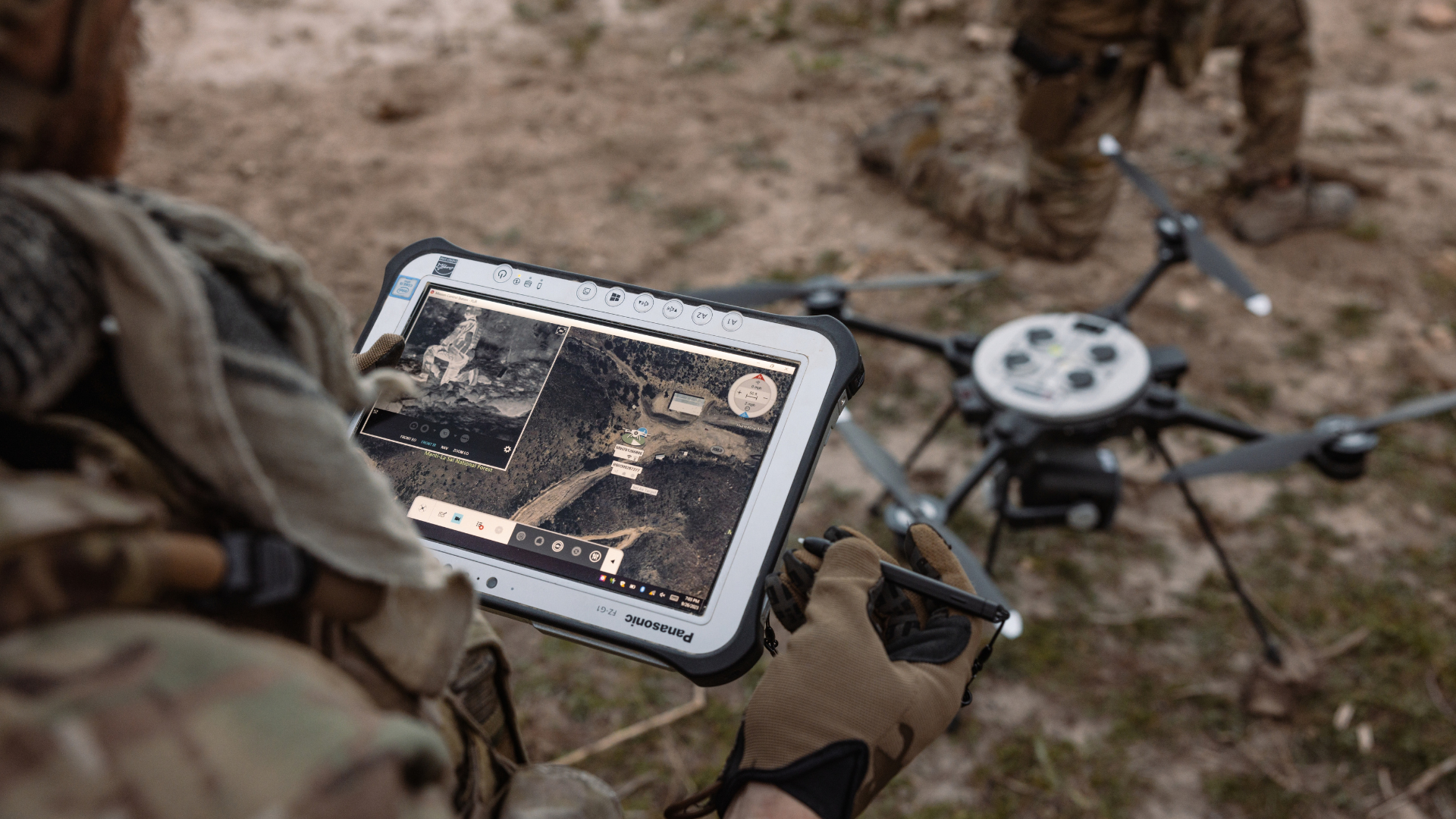
While many of us think of any remote-controlled helicopter or plane as a drone, that’s selling them a bit short. These UAVs are part of a larger system that includes a control station, communication equipment, payload and flight planning software. It’s an evolving system, too, with artificial intelligence (AI) playing a growing role in everything from flight planning to empowering a UAV to make real-time decisions in the field.
As the principal product manager in Teledyne FLIR’s UAS division, Cunha has spent the last almost 15 years working with clients worldwide to deploy UAV solutions in public safety, defence, agricultural and industrial applications. Cunha has worked for the company through several acquisitions, starting when it was Aeryon Labs. Along the way, he has gained unique insights into how UAVs are changing the defence industry, and how Waterloo is making that change possible.
The story isn’t just interesting as a study of how innovation happens, but also as a case study for how expansion and acquisition can radically change a company’s capabilities.
From joystick to point-and-click
“Aeryon Labs was founded in 2007 by a couple of University of Waterloo grads with the mission to make the operation of small unmanned aerial systems (UAS) easy to operate for any user,” Cunha says.
At the time, most UAVs were flown like radio-controlled planes using a joystick. Those systems required a high degree of expertise and training. Aeryon’s founders set out to develop a point-and-click UAV solution.
“We wanted to reduce operator training and basically democratise the ability to fly these systems,” he says.
The company’s innovations changed the way UAS systems were designed across the industry. That innovation caught the eye of Wilsonville, Oregon–based FLIR Systems, a developer of thermal imaging systems for aerial vehicles. The two companies quickly developed a partnership to use FLIR Systems’ sensors as payloads on Aeryon’s UAVs.
“As time went on and the UAV industry evolved, FLIR’s customers were increasingly asking them to not just buy sensors but provide solutions to their problems. So they looked at companies like Aeryon Labs as a really good fit to provide not just small capabilities, but full solutions they could provide to their customers,” Cunha says.
FLIR Systems acquired Aeryon Labs in 2019, with the UAV team remaining in Waterloo.
In 2021, Teledyne Technologies (the parent company of Teledyne DALSA, which also has a facility in Waterloo) acquired FLIR Systems. The two companies operated in the same market with a complementary set of sensors and business offerings. It was a match that just made sense.
“With the acquisition, we were able to provide holistic solutions to our customers made up of multiple systems and sensors to solve virtually any challenge,” he says.
Setting course for an autonomous future
Defence and public safety continue to be two of Teledyne FLIR’s main focuses, but innovations in autonomy and edge intelligence are opening new opportunities for the UAV leader. Cunha says the company’s research is enabling these systems to do more with less direct instruction from UAV operators.
“The systems can make better decisions faster with less inputs and as importantly, provide relevant context and information back to the operator in a way they can understand,” he says.
After two acquisitions, Teledyne FLIR’s team continues to evolve how UAVs are piloted, including adopting AI technologies.
“We’ve always been focused on improving how people could use the tools we built,” he says. “Originally, that meant going from RC joystick control to touch-based controls. Today, that means working to bring in AI and autonomy tools that allow the systems to better understand the operator’s intent.”
UAVs like Teledyne FLIR’s are loaded with sensors that capture data. The company’s systems can use that data to develop a plan and take action without the operator’s input. Think of a UAV performing a search and rescue flight. If there’s a sudden change in weather conditions, the UAV can alter its flight plan to complete the mission. It’s real-time intelligence where it matters most.
And most recently, the priority has become defence and sovereignty.
“As anyone that’s seen the news lately can see, uncrewed aerial, ground and maritime systems are proliferating throughout the defence space. Using UAVs as a tool for reconnaissance and other uses is becoming increasingly important,” he says. “Those are the types of missions that we’re working on developing now.”
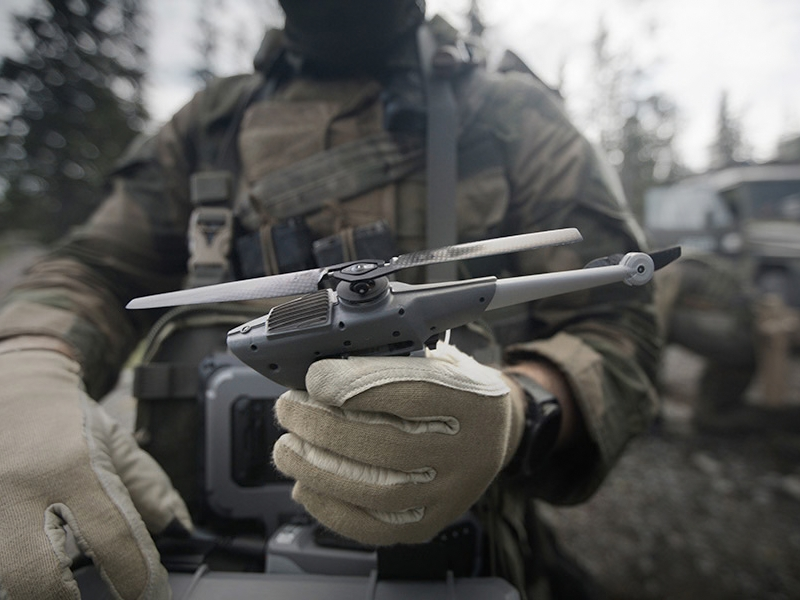
Teledyne FLIR’s Black Hornet drone
Taking off from Waterloo
With roots in a made-in-Waterloo tech company, Teledyne FLIR continues to take advantage of the region’s business ecosystem. Cunha says the mix of hardware and software expertise, the RoboHub at the University of Waterloo and manufacturing leaders give the company the lift it needs to evolve its products and expand into new markets.
“Not only all the expertise, but it’s also Waterloo’s entrepreneurial mindset,” Cunha says of the area’s researchers. “They’re technically capable and motivated to develop new solutions and remix existing technologies into novel capabilities.”
The company continues to tap into the same post-secondary institution that inspired its founders. He points to UWaterloo’s mechatronics and robotics programs and its co-operative education program, which is how Cunha originally joined the company.
“The University of Waterloo has many of the things that we especially need expertise in — robotics, hardware, software and embedded systems development,” Cunha says. “Having all of those disciplines available is extremely beneficial to us.”
Teledyne FLIR and the University of Waterloo
As dual-use continues to grow, Cunha says Waterloo has all the ingredients for any company looking to build defence-focused products.
“Waterloo Region is uniquely well-suited to defence development because it has a depth and wealth of technical expertise from hardware to software to embedded systems. It has world-leading research centres in aerospace, AI, robotics and quantum computing,” he says.
The environment also makes Waterloo a top choice for companies in the hardware and defence space.
“Living in an area that has a wide array of environments and some pretty extreme weather, Waterloo is a great place to put practical products to the test and make sure that they’ll operate in some of the most extreme environments on the planet,” he says.
And Waterloo is uniquely capable of turning that data, along with our talent and expertise, into products that work.
“There is certainly not as much emphasis on hype as there is on building real things, solving hard problems and making sure that you deliver on what you say you would deliver on,” Cunha concludes. “And it’s that kind of credible product development and real-world demonstration that’s appreciated in the defence space.”
The Summary
- FLIR Systems acquired Aeryon Labs in 2019, and Teledyne Technologies acquired FLIR in 2021, turning the company from a UAV hardware maker into a provider of full sensor-and-systems solutions for defence, public safety, agriculture and industry.
- Aeryon Labs, founded by two University of Waterloo grads in 2007, replaced complex RC-style flight controls with simple, “democratized” point-and-click operation, reshaping UAS design industry-wide.
- Teledyne FLIR is building autonomy into its systems so UAVs can interpret operator intent, adjust flight plans in real time and relay clear context back to human operators.
- The region’s hardware and software talent pool, University of Waterloo research programs, extreme-weather testing conditions and quality of life make it a strategic base for defence and UAS innovation.
Want to learn more about robotics in Waterloo?
Get a full list of robotics and automation companies working in our community.