
The short version
The Waterloo Institute for Sustainable Aeronautics is a valuable resource for innovation-focused aerospace companies, providing help navigating the University of Waterloo, forging connections with researchers and top talent, and providing access to the “living lab” at the Region of Waterloo International Airport.
Waterloo is an innovation-driver across many industries. We have leaders pushing into new frontiers in everything from quantum computing and health tech to advanced manufacturing and nuclear power. But there’s another industry that Waterloo Region leads in that doesn’t get the headlines it deserves: aerospace.
That’s right. The Waterloo region has quickly (and quietly) built a reputation as a global hub for aerospace innovation. One of the people leading that charge is Dr. Suzanne Kearns, founder and executive director of the Waterloo Institute for Sustainable Aeronautics (WISA) at the University of Waterloo.
Founded in 2021, WISA is a research institute tasked with helping address some of the most pressing challenges facing the aviation and aerospace sectors – environmental pressures, workforce shortages and rapid technological change. It takes an interdisciplinary approach to connecting those challenges to the university’s broad research strengths, supporting a more sustainable future for the aviation and aerospace sector.

Dr. Suzanne Kearns, Founder and Executive Director of WISA
“When you look across the campus at the University of Waterloo, you see so many research innovations in so many different areas. We started thinking that if we could help those researchers understand how their work can connect to aviation and aerospace challenges, that we could do some really amazing work,” Kearns says.
Key Takeaways
- WISA is a strategic gateway helping businesses navigate the University of Waterloo, connect with the right researchers and tap into funding programs that multiply their R&D investment.
- The Region of Waterloo International Airport functions as a “living lab,” giving companies a rare environment to test and validate new technologies with researchers, operators, and Transport Canada all at the table.
- Waterloo offers a built-in talent pipeline for aerospace and aviation businesses, anchored by Canada’s largest pilot training degree program, the University’s co-op program and graduate researchers who often become direct hires for industry partners engaged with WISA.
- Waterloo’s aerospace ecosystem is built on collaboration, not competition. WISA works hand-in-hand with AeroWR, other University of Waterloo research institutes (AI, robotics, quantum, climate) and industry partners, giving incoming companies access to a connected community rather than siloed resources.
Tackling aviation’s three biggest threats
Kearns started WISA with a question: What are the biggest threats facing the future viability of aviation? The answers to that question were quickly apparent.
Aviation today is facing three critical challenges: a workforce shortage, a growing hostility to aviation because of its real (and perceived) environmental impacts and the fast evolution of technology across the industry. As a result, WISA organizes these challenges around the three pillars of sustainability: social, environmental, and economic. Kearns points out that the institute’s logo has three pillars holding up aviation.
“Since we’ve launched, our focus has been on catalysing research in those three pillars,” says Kearns. “In social, everything from pilot training and human factors to flight physiology and pilot mental health. In environmental, looking at things like solar panels on hangars and sustainable fuels. Lastly, for economic, it’s everything else—optimization, cybersecurity and other technologies that pose both opportunities and challenges for businesses.”
How WISA connects aviation companies with innovative ideas
For an aviation business with a research question, walking up to a university the size of Waterloo can be daunting. Who do you talk to? Where do you start? Which of the thousands of faculty, staff and students is working on something that connects to your problem?
That’s where WISA comes in. For businesses looking to plug into aerospace innovation, WISA isn’t just a research institute. It’s a shortcut.
“WISA can be a very effective bridge where we can help them navigate all the different stakeholders within the university system to help match them with research collaborators,” she says.
It’s not just helpful for large enterprises either. Kearns says WISA is making an impact for small to medium enterprises. The organization also has a strong grasp on available government support programs – grants and tax credits – that help companies access high-skill talent and deliver a strong return on their research investments.
Research is only part of the benefit of working with WISA and UWaterloo. The university’s world-renowned co-operative education program is placing talented students with leading aerospace companies across Canada and around the world.
“We love it when our partners hire our students, whether that’s co-op or research projects that support our masters and doctoral students. And those students, once they graduate, they’re often looking for employment and the companies who have been engaged with us throughout that cycle have a direct line to hire some really talented people to support their operations,” she says.
An airport, an electric plane and 300 test flights
Ask Kearns what makes Waterloo’s aerospace ecosystem different, and the conversation quickly turns to the Region of Waterloo International Airport (YKF).
“We at WISA like to think of our airport as a bit of a living lab,” she says. “We have lots of examples where we’ve worked with stakeholders at the airport to test and validate new technologies that are being experimented with or developed by researchers.”
The airport is where WISA’s research leaves the page and meets the runway and where the institute’s relationships with operators, flight schools and regulators come together in a way that’s hard to find anywhere else in Canada.
Before any vehicle can move from lab to air, it has to be rigorously tested and certified. Achieving certification can be a difficult process for businesses, but Kearns notes that the Waterloo Region aerospace ecosystem is unique because of the close alignment with the airport. One example is the Pipistrel Velis Electro, which WISA acquired and helped earn Transport Canada approval by collecting necessary data.
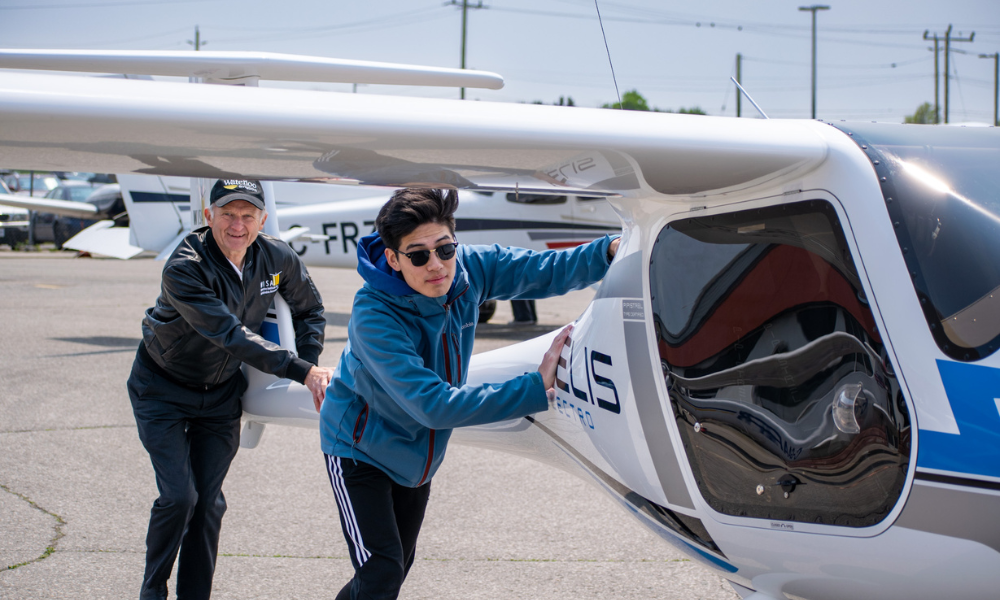
From left: Paul Parker and Tyler Jing conduct research on the Pipistrel Velis Electro (2023).
“We partnered with the Waterloo Wellington Flight Centre (WWFC) at the airport and we hired our students as pilots to fly the aircraft and collect data. They completed more than 300 flights to collect data that researchers at the university analyzed and sent to Transport Canada to show that that aircraft is viable,” Kearns says. “It’s a really good model of what’s possible when everybody works together.”
WWFC recently announced new scenic flights in the Velis, giving members of the public the opportunity to experience electric aviation firsthand and imagine a more sustainable future for the industry.
"My dream is that other people around the world will say ‘Waterloo’ and they’ll go, ‘oh, don’t you guys have an amazing aerospace innovation sector?’"
Dr. Suzanne Kearns
Founder and Executive Director of the Waterloo Institute for Sustainable Aeronautics (WISA)
Waterloo is the aerospace hub hiding in plain sight
Aerospace innovation in Waterloo doesn’t happen in isolation. WISA works alongside other research institutes at the University of Waterloo in artificial intelligence, robotics, quantum computing, climate and more.
“The more talent that we can bring in to help us address the big challenges facing the future viability of aviation, the better off we are,” Kearns says.
That same collaborative instinct extends beyond campus. WISA partners with AeroWR, the regional body bringing together the Waterloo area’s aerospace and defence community, to make sure research makes its way into industries.
It also opens up opportunities in dual-use research, where the same innovation can serve both civilian and defence applications. Take human factors research, for example. The work WISA researchers are doing on eye-tracking and sensor-based learning to train pilots more effectively applies just as well to military aviation as it does to commercial flight schools.
“I don’t see it as being necessarily at odds,” Kearns says. “There’s a lot of insights that maybe haven’t previously been translated between civil to defence, and there’s a lot of interest in our community in that space.”
Ask Kearns what makes Waterloo’s aerospace ecosystem stand out and her answer is quick: innovation, collaboration and sustainability. And she has a vision for what comes next.
“My dream is that other people around the world will say ‘Waterloo’ and they’ll go, ‘oh, don’t you guys have an amazing aerospace innovation sector?’”
Soar in Waterloo's aerospace ecosystem
Discover the companies and research institutions like WISA driving innovation, collaboration and sustainability in our aerospace industry.