The short version
The Waterloo RoboHub at the University of Waterloo, the largest robotics and automation research group in Canada, is playing a key role in building the trust necessary for people to accept robots in their daily lives. To do this, they’re working closely with community groups and industry partners, providing opportunities for human-robot interaction and resources for researchers and companies that want to continue to drive innovation in robotics.
Robots, called physical AI by some, are having more than a moment. They have moved beyond advanced manufacturing and heavy industry into human environments, from health care to recreation. As daily interactions increase, researchers at the Waterloo RoboHub are tackling the defining problem in human-robot interaction: What makes a robot trustworthy?
From The Jetsons’ Rosie to the droids of Star Wars, pop culture often imagines humans and robots living happily side by side. In reality, most robots work inside cages to keep people safe. San Francisco’s delivery robots are light, slow, tightly geofenced and often need remote human intervention. Human-robot partnerships remain rare, and their success hinges on trust.
That’s where the Waterloo RoboHub at the University of Waterloo comes in. The RoboHub has Canada’s largest robotics and automation research group, with over 50 faculty working to solve problems in human-centred robotics and autonomous systems, with the objective of proving that they can be around humans, no matter what. Only then, RoboHub experts say, will humans accept robots in their daily lives.
Robotics research, education and outreach under one roof
Founded in 2017, the RoboHub began as a shared Engineering research space for Waterloo students and professors with a few big-ticket robots and sensors. It quickly became a broader community hub.
“From day one, we quickly realized that supporting robotics research was just one of the many things we would be doing. The interest in robotics is truly phenomenal,” says Brandon J. DeHart, Waterloo RoboHub’s manager and an adjunct assistant professor in Engineering.
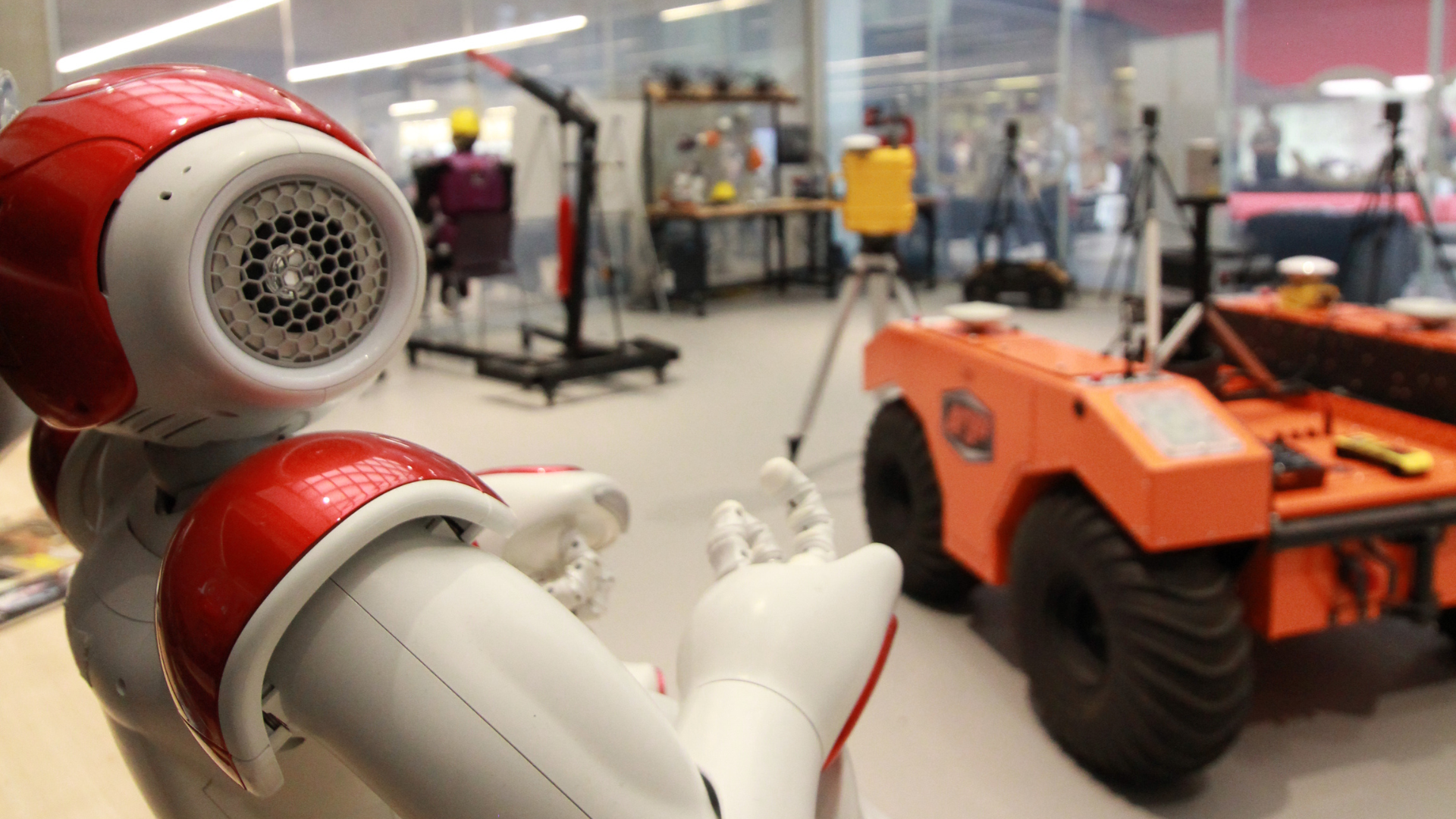
The glass-walled, two-storey, 10-metre cube sits in the busy atrium of the Pearl Sullivan Engineering building at the heart of the Faculty of Engineering. It holds robots of every size and shape, from full-scale humanoids and squat wheeled platforms to the toddler-sized “Nao” that children love.
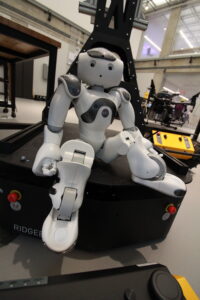
The “Nao” robot is a hit with younger visitors to Waterloo RoboHub (photo credit: Waterloo Engineering at the University of Waterloo)
And yes, kids are now part of the RoboHub, as programming includes K–12 educational outreach, undergraduate and graduate courses, workshops, labs and executive training and professional development. That’s in addition to RoboHub’s core research collaborations with organizations like the Natural Sciences and Engineering Research Council of Canada (NSERC) and Mitacs.
Having groups of 9-year-olds learning about robots doesn’t distract the researchers and staff from the organization’s central goal. Instead, it inspires them to bring the application, acceptance and trust of robots into the world, says DeHart.
RoboHub experts sit on a dozen standards committees, helping create the safety standards that enable trust. “What will happen in the real world is what the robot is judged against,” DeHart says. As human-centric robotics standards emerge, Waterloo’s participation ensures Canadian sovereign interests are represented.
Why trust is the biggest challenge facing robotics today
For all of RoboHub’s research expertise, DeHart says robotics’ biggest hurdle is human, not technical.
“Do you trust the hardware?” he asks. “Do you accept having that robot in your space?”
Those questions will decide how quickly robots move from labs and factories into hospitals, homes and daily life.
Trust-building spans several fronts. Robotics is inherently dual-use: the same sensors, arms and mobile systems have civilian and defence applications. RoboHub sees growing interest in distinctly Canadian challenges, including Arctic operations and resource extraction in extreme geography.
Health care is another frontier that the RoboHub is tackling. With the Waterloo Regional Health Network’s new hospital planned for the University’s North Campus, RoboHub is helping map out what warehouse-style logistics automation could look like inside a hospital. DeHart points to robots potentially freeing up nurses and other specialists from the menial tasks of moving carts and tracking inventory so they can spend more time on patient interaction and expert services.
“I think these examples are indicative of where robotics is heading, because it’s a very interdisciplinary space. Robots are moving out of factories and warehouses. There are exponentially more people, fields and domains that need to get involved as that transition happens,” DeHart notes.
Helping startups and industry solve robotics integration challenges
Corporations, scale-ups and startups often ask RoboHub which robot form fits the job. Its expertise spans global providers, multiple forms and human-robot deployments where people work alongside a mixed fleet. Many organizations want robots to function in human environments rather than rebuild facilities around machines. Waterloo focuses on human-first robotics.
RoboHub researchers also help robots “talk” to each other, share information and avoid duplicated work across human-robot teams, says DeHart.
“Maybe there are people remotely teleoperating. Or people working directly with the robot. There could be five different kinds of robots on a construction site doing an inspection. These systems often don’t talk to each other out of the box, or there are significant hurdles to making that work, and we figure that out for them.”
Much of this work advances technology while it is still being invented.
“So much of it doesn’t really exist yet, or it’s only very new, fledgling work. Many of the startups working in that space are also our partners who we’re helping to expand in that realm,” he says.
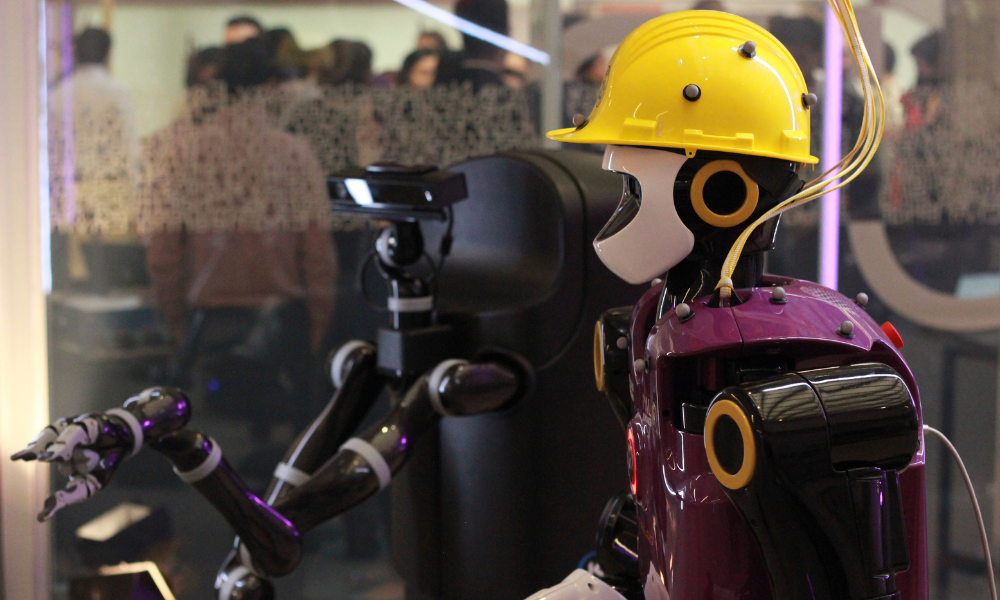
Robots at Waterloo RoboHub (photo credit: Waterloo Engineering at the University of Waterloo)
How Canadian businesses can test robots at Waterloo RoboHub
RoboHub’s work doesn’t stop where research ends. It is rapidly becoming the nation’s proving ground for human-centred robotics, along with establishing deployment pathways for the creation and scaling of world-class companies right here in Canada.
Key to this is their Professional Partnership Program, which includes the Connected Robotics Living Lab, run in tandem with Rogers and CENGN, Canada’s Centre of Excellence in Next Generation Networks. Through this partnership, small and medium-sized businesses can try out a mix of robots on their own problem before committing to anything. They get access to the equipment, the expertise of researchers who design around the people doing the work, wireless connectivity from Rogers and funding from CENGN to make it affordable. A similar program with the Ontario Centre of Innovation is just wrapping up, which served Ontario businesses with fully-funded access to similar services with RoboHub.
RoboHub also runs a matchmaking program that connects businesses with existing partners.
“A lot of the time, companies come to us looking for solutions to problems, and we can point them at one of our partners and say, this company sells 90% of what you’re looking for. Let’s help you with the piece that doesn’t exist yet,” DeHart says.
For professors outside of the university and independent researchers, the RoboHub has a Canada-wide research membership program that gives non-Waterloo researchers effectively the same level of access and support as on-campus researchers, including the robot lending library, software repositories, access to expertise, and the ability to send students to the RoboHub space to use its robots for experiments. This strengthens Canada’s entire robotics ecosystem, says DeHart.
“It’s imperative that Canada builds its robotics industry from within, as we no longer have easy access to the US market due to recent FCC rulings designed to keep non-US robots out of their country.”
Geopolitical rulings aside, DeHart emphasizes that Canadians want their robots to be tested and trusted on Canadian values and standards, as well as being able to survive and thrive in Canadian environments.
Robotics partnerships for startups, scale-ups and industry
For companies where the government-supported programs don’t apply or who are at an earlier Technology Readiness Level (TRL), DeHart says RoboHub’s Professional Partnership Program is the easiest way to connect with the RoboHub.
The program connects industry, research institutions and startups with Waterloo’s robotics community. It offers event and marketing access, recruitment support, student engagement, concierge service with manufacturing and training partners, and access to RoboHub’s growing fleet of robots and sensors.
“We’re up to more than 70 robots and dozens of specialized sensors at this point. That spans wheeled, legged, flying and magnetically levitated systems. Scale-wise, they go from Roomba-sized indoor systems up to an amphibious, autonomous, articulated ATV,” he says.
The hub’s robot fleet has been used for everything from novel sensor development to developing backend solutions to manage robots in the field to user studies in schools and long-term care facilities. DeHart says the hub has worked with companies including Kinova Robotics, Avidbots, Clearpath Robotics (which was acquired by Rockwell Automation in 2023) and Axibo. RoboHub’s fleet, along with its robot “wranglers,” also appears in science-fiction television series and The Amazing Race Canada.
It is a future with “Made in Waterloo” written all over it, DeHart says. The region’s manufacturing history and expertise in software and AI support advances in robotics across every industry.
“You have direct, connected access to all of that without dealing with the challenges of being in a big city. You have support for workforce development, for talent coming in, whether from Canada or beyond,” DeHart says. “There’s a robust ecosystem across basically every vertical, and yet it feels like a small-town community. It’s a good place to be.”
Discover the future of robotics
It’s being invented right here in Waterloo.