
The short version
The University of Waterloo’s creator-owned IP policy attracts entrepreneurial people to our ecosystem, creating a community of leaders who are willing to take risks and start new ventures.
If you wanted to describe Waterloo in two words, the first would be collaboration. The second: entrepreneurship. This is a community that has engineered entrepreneurship—and the tolerance for risk that comes with it—into its DNA, and the results are eye-opening. Recent reports have suggested that 20% of Canada’s tech founders are graduates from the University of Waterloo (UWaterloo).
Our culture of risk-taking encourages people to turn innovative ideas into reality. We enable builders, which is why the Waterloo region is often the birthplace of incredible inventions in tech, robotics, cybersecurity, quantum and more.
This ethos is driven by UWaterloo’s unique intellectual property (IP) policy and the community’s mindset toward collaboration, innovation and building.
Waterloo has an entrepreneurial ethos
Some say Canada has a problem taking risks. The country can be seen as overly cautious when it comes to starting new companies and building cutting-edge technologies.
Waterloo suffers from no such fate.
From BlackBerry to Clearpath Robotics, risk underpinned all successful companies that started and stayed in the Waterloo region. People here are willing to explore and experiment. People are willing to fail in order to be successful. These qualities are inherent to entrepreneurs and innovators.
“We need to take the Waterloo ecosystem and ethos of taking risks … and build it into our procurement system,” said Mike Peasgood, CEO of ENVGO, at a dual-use event at Communitech during Waterloo’s annual Tech Week. He was discussing the national defence procurement system, but the sentiment is applicable in several contexts. Canada needs more Waterloo. So, how did we foster this kind of culture? What effect has it had on the industries that proliferate here?
It all starts with UWaterloo, which acts as a magnet for drawing entrepreneurial people to our ecosystem.

Communitech’s Dual-Use Summit taking place in September 2026 (Source: Communitech)
UWaterloo’s IP policy promotes innovation
Established in 1957, UWaterloo’s primary focus was engineering, mathematics and science. Its founding members’ goal was partly to produce “engineers to accommodate the postwar industrial boom” (The Walrus). Co-operative education was embedded in the engineering program from the get-go.
It set the university on an unusual trajectory for the 1950s, when most schools were grounded in religious affiliation or emphasized the study of the humanities. Its technical and innovative roots led to the creation of the school’s unconventional IP policy in 1973, which allows students and faculty to own their IP. Everything you discover at UWaterloo, says the university, belongs to you.
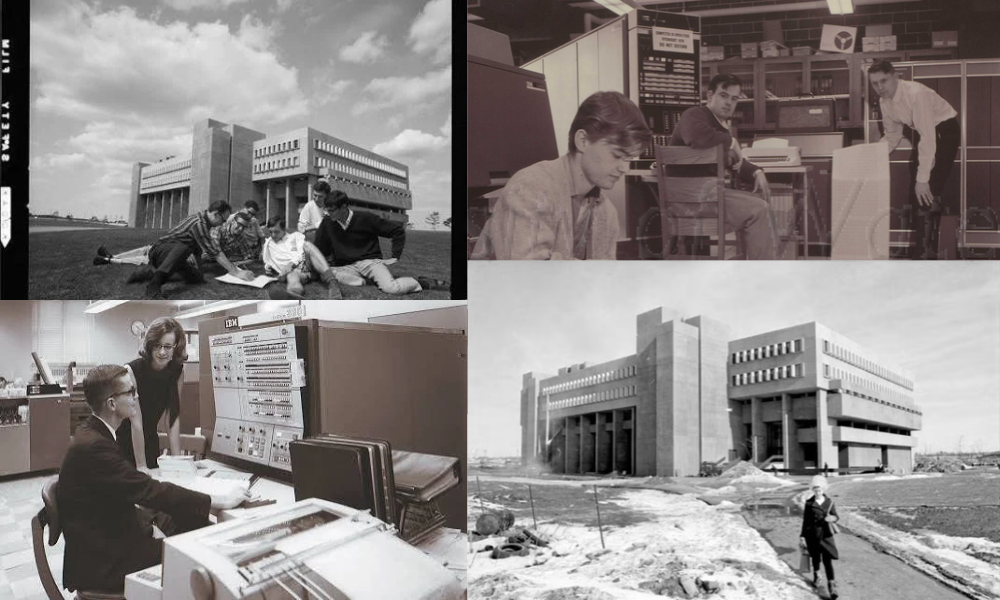
Archival photos from the University of Waterloo, displaying the university’s first mathematics and computer building, and some of the first students enrolled in co-op, mathematics and engineering (Source: University of Waterloo)
The combination of creator-owned IP and co-operative education was—and continues to be—a catalyst in the Waterloo area. The opportunity for ownership attracts entrepreneurial researchers to the university. Like-minded students who wish to learn from these academic leaders apply to the university’s programs. They enroll in co-op, spending time at local companies and research hubs. They work with business leaders and learn what it means to be an entrepreneur. The circularity of innovation becomes apparent: UWaterloo’s IP policy permits students to protect what they build. And companies are born.
An article from The Walrus explained that “the practice creates incentive, and there’s little downside … The arrangement also helps foster a symbiotic relationship between the outside world and the school.”
What innovators are building in Waterloo
Waterloo is one of the top patent-filing jurisdictions in Canada, and UWaterloo is ranked #7 in the world for entrepreneurship. Local businesses hire entrepreneurial talent with first-hand experience from startups, co-op placements and research labs like Waterloo RoboHub and Waterloo Data and Artificial Intelligence Institute. Companies emerge left, right and center from faculty and students.
BlackBerry, a pioneer in tech and cybersecurity, is one such example. Its co-founder, Mike Lazaridis, was a UWaterloo graduate, attracted to the university for its co-op program and hands-on ingenuity. “[It] was an engineering school. This guy built a computer, that guy built a radio control system, everybody built something or at least had an interest in building something,” said Lazaridis, quoted in Maclean’s in 2012.
After the business contracted, “more than 450 startups opened for business in [the Waterloo region in 2013], more than four times the number launched in 2009,” CNBC reported in 2014. What happened in the community in 2012? Amid a business collapse, BlackBerry cut thousands of jobs. Those people leaned into our risk-taking, entrepreneurial culture and went on to start – or support – several successful startups like Vidyard, Aeryon Labs, ISARA Corporation and Cognitive Systems.
Waterloo is full of early movers who took risks to reach the level of success they enjoy today, many of which are affiliated with UWaterloo in some capacity: OpenText, Square’s CashApp, Clearpath Robotics (acquired by Rockwell Automation), eSentire, Faire, Miovision and more.
Local incubators and innovation hubs add fuel to the flames. Velocity, the University of Waterloo’s incubator, orients students toward a builder’s mindset. To date, the incubator has produced 500+ startups and 1,200+ founders, and its companies have raised $40B in collective enterprise value.
How businesses that expand here can benefit from our building mindset
If your company expands here, you’ll be able to access entrepreneurial talent, researchers and a community that has a long history of building. You’ll collaborate with top-tier companies and research institutions, many of which are based out of UWaterloo. You’ll tap into a community that is ambitious and willing to take risks, and join a legacy of organizations drawn to the area for its innovative spirit. In Waterloo, you’ll be in good company.
The Summary
- The University of Waterloo’s IP policy lets students and faculty own what they invent, which attracts entrepreneurial researchers and students to the Waterloo region.
- Co-op education places students in local companies and research labs, so they graduate with real startup and building experience.
- After BlackBerry cut thousands of jobs in 2011 and 2012, former employees started companies like Vidyard, Aeryon Labs and Auvik Networks.
- Velocity, the university’s incubator, has produced more than 500 startups and 1,200 founders, with $40B in collective enterprise value.
Discover the ecosystem that shapes companies in Waterloo