Waterloo has developed a reputation for applied artificial intelligence, and behind that reputation is one of Canada’s premier AI research organizations: The Waterloo Data and Artificial Intelligence Institute. Not only does it sharpen the cutting edge of AI technologies, but it plays a key role in helping companies apply these technologies across industries.
The Waterloo Data and Artificial Intelligence Institute (Waterloo.AI) at the University of Waterloo is one of a growing number of research institutes and universities globally working to build the future of artificial intelligence (AI) and machine learning (ML) systems. But Waterloo.AI’s approach sets it apart.
Alongside its foundational research, the institute works directly with industry partners to apply cutting-edge AI research to today’s challenges and tomorrow’s opportunities.
“We don’t just write papers,” said Stephen L. Smith, Director of Waterloo.AI. “We work directly with stakeholders to solve real-world problems and we work to take theory and make it work in practice. It’s rooted in our foundation as an engineering-driven, co-op university. That’s the founding principle of UWaterloo, and it’s really present in the institute.”
Key Takeaways
- Waterloo.AI is the University of Waterloo’s hub for foundational and applied AI, spanning all six faculties and more than 200 faculty members. It’s built specifically to move AI out of academic papers and into real deployments for industry partners.
- Companies can engage with Waterloo.AI in two ways: a lower-commitment sponsorship model that provides talent access and upskilling or a deeper research engagement where the institute acts as an external R&D team that handles the research and supports technology transfer into a company’s operations.
- Waterloo.AI’s applied work already spans multiple sectors — from an agentic AI system being developed with global chemicals leader BASF to AI-driven simulation for turbine engineering in aerospace to efficiency-focused AI for the insurance industry — proof the model scales well beyond any single vertical.
- Physical AI and robotics is where Waterloo’s edge is sharpest: the region pairs world-class research in autonomy and human-robot collaboration with an established robotics industry giving companies rare access to both deep research and real deployment infrastructure.
The big four at Waterloo.AI: health, robots, security and a strong foundation
Waterloo.AI has been putting foundational and applied AI research into action since its founding in 2018. The institute spans all six of the university’s faculties, from arts and engineering to environment and math with over 200 faculty members and their research associates taking on challenges that affect not just industries, but all of society.
True to the university’s mission, Waterloo.AI tackles these challenges with an eye on the social, ethical and policy implications of AI. While the institute can help with virtually any project, Smith says there are three areas of focus that he is seeing heavy interest in — AI for health and science, physical AI and secure and responsible AI – all underpinned by the institute’s fourth research cluster, foundational AI.

Dr. Stephen Smith, Professor, Canada Research Chair, Director of the Waterloo Data & Artificial Intelligence Institute
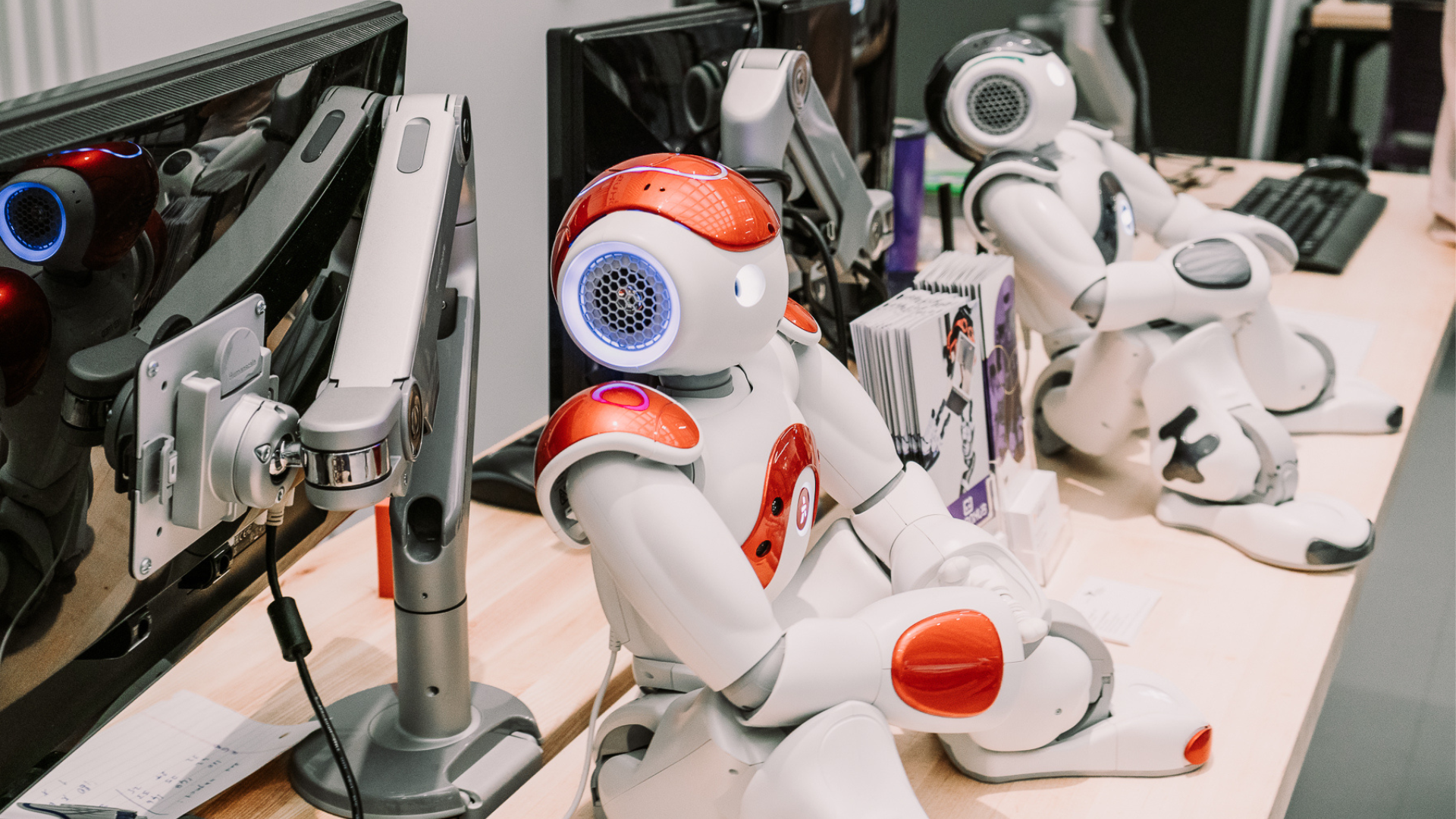
“We have quite a few projects at the institute where AI researchers are working together with scientists to speed up work in areas like astronomy, bioinformatics and climate modeling. Then a second area is what we call embodied or physical AI. This is essentially robotics and autonomy, where we’re taking the principles of AI and deploying them on physical systems,” he says.
The third area of focus — secure and responsible AI — is critical to making sure the AI solutions developed don’t become the privacy-invading, rule-breaking villains of a sci-fi blockbuster. Smith says there’s a lot of momentum in this area, especially in collaboration with the university’s Cybersecurity and Privacy Institute.
“We’re looking at the ethical and legal implications of AI, how we maintain security in AI systems and making sure they’re safe, compliant, and actually benefit society,” Smith says.
Two ways to partner with Waterloo.AI
Companies looking to partner with Waterloo.AI have two ways to engage. First, the institute offers a sponsorship model that provides access to the institute’s events and some academic.
“Waterloo is well known for sending talent out to companies, but something we offer for our partners is the ability for their employees to come to campus for different events and upskilling opportunities,” he says. “These are a great way to get industry exposure to the latest research in data science and AI.”
Smith adds that many of the upskilling opportunities are offered in partnership with WatSPEED, the university’s professional education arm.
The second partnership path is research engagements. Waterloo.AI offers partners the ability to research and design a solution without the company having to recruit an in-house AI team.
“We can essentially act as the external R&D wing for a company on a specific topic,” he says. “Companies often use this to explore new ideas or technologies quickly, without the overhead of hiring a full team. This can take the form of shorter-term engagements or longer-term collaboration.”
Smith is quick to point back to the institute’s key differentiator — “We don’t just write papers.”
“We use the phrase ‘operational AI.’ That means we’re not just looking to hand the company a research paper at the end of it and say, ‘here you go, good luck.’ We really try to help with technology transfer and figure out how to get AI into the actual workflow of the company,” Smith says.
At the core of both sponsorship opportunities and research is one of the University of Waterloo’s most valuable resources — its talent. Industry sponsors can participate in career fairs and post AI-related positions on the university’s co-op job placement system. But it’s the research projects that Smith points to as a particularly strong source of access to talent.
“You have graduate and undergraduate students working on projects related to the company, and those are the perfect people to be recruited by the company afterward,” he says.
Applied AI solutions for real-world problems
Going back to the institute’s cross-faculty foundation, Smith gives the example of a research project with Germany-based BASF. The chemical industry company is a world-leader, and the institute is working to develop an agentic AI system to help the company’s chemists navigate complex chemistry challenges.
“That’s quite a large project, and it draws from both the foundational AI side and also chemical engineering,” he says.
On the aerospace side, Waterloo.AI is working with a partner on building an AI-driven simulation system for turbine development.
“When you’re building things like turbine engines, there are very complex fluid simulations that have to be performed. Some of these can be sped up and made more accurate with AI techniques,” Smith says.
Waterloo is one of North America’s densest insurance clusters, and leaders like Manulife have put Waterloo.AI to work. “We’re looking at the next generation of AI to improve efficiency across the insurance industry,” Smith says.
The area that Smith is most excited about is physical AI and robotics — something he admits he’s a little biased towards as a robotics researcher.
“I really believe Waterloo is uniquely situated in this area. We have truly world-class researchers here — people in foundational AI, but also in autonomy. And we have a lot of strength in social robotics and human-robot collaboration, really thinking about how robots are going to operate around and among people,” Smith says.
Waterloo is home to robotics leaders like Clearpath Robotics (now part of Rockwell Automation), Avidbots and Swap Robotics, as well as top automation companies like ATS Corporation and Eclipse Automation. Smith says the mix of robotics research and real-world applications gives Waterloo a unique edge in integrating AI into physical systems.
“It can be a robot, but it can also be anything where you have things moving in the real world and possibly interacting with humans. I think this is a real opportunity — we have the expertise here to make this work, and we’ve already got the industry ecosystem surrounding all of it,” he says.
Waterloo's Research Atmosphere
Waterloo is a big opportunity for companies seeking an AI edge
For companies looking at international expansion or relocation, Smith says Waterloo has all the ingredients to develop the next generation of foundational AI solutions and put them to work.
“You can see it even from the industry collaborations I mentioned — we don’t operate in a vacuum. We are what we are because we have these collaborations with industry, and we have a big advantage because of the industry that surrounds us in the region,” he says.
It’s not just the diversity in industries that gives Waterloo an edge as an ecosystem.
“It’s the wide range of industry and also the proximity — everything in the Waterloo region is close to campus, so it’s easy for us to collaborate with different industries. We have everything represented, from manufacturing to robotics to insurance to banking — it spans the whole gamut,” Smith says.
Interested in learning more about research partnerships at the University of Waterloo, Canada’s top comprehensive research university? Learn how you can tap into R&D expertise, recruit talent and more at UWaterloo.