The short version
Waterloo’s robotics and automation talent pipeline runs through three schools: the University of Waterloo for engineering and hardware, Wilfrid Laurier for software and AI and Conestoga College for skilled trades. Together, they produce the machinists, electricians, engineers and developers that robotics firms and advanced manufacturers need to build their teams.
Robots are full of potential. So are the students creating them. Our young workforce, emerging from the three local post-secondary institutions, fuels our robotics and automation cluster—the largest in Canada.
From medicine to manufacturing, robots and other forms of physical AI can make the world a better, safer place. Students, armed with the problem-solving skills and innovation mindset that come from earning an education in Waterloo region, are best positioned to invent the future with robotics.
Educated at the University of Waterloo, Wilfrid Laurier University and Conestoga College, these students bolster our robotics and automation talent pool. The combination of talent maps onto the needs of robotics firms, automation integrators, automotive suppliers, machine builders and advanced manufacturing companies.
If you see yourself on that list, you can start building your workforce with graduates from these programs.
Key Takeaways
- With engineering programs in mechatronics and systems design, as well as the Waterloo RoboHub, the University of Waterloo is at the forefront of robotics and automation innovation and plays an instrumental role in educating students to make an impact in the industry.
- Wilfrid Laurier University equips students with the software and AI skills required to train autonomous systems and intelligent machines.
- Conestoga College rounds out the Waterloo region’s talent pipeline with skilled trades and applied technology programs that produce the electricians, machinists and technicians needed by the robotics sector.
University of Waterloo
The University of Waterloo (UWaterloo) is uniquely situated to advance the potential and power of robotics and automation. The school’s engineering department has the largest and most active robotics and automation research group in Canada.
Related research hubs at UWaterloo include—but are by no means limited to—the Waterloo Data and AI Institute, Autonomous Systems Lab and Centre for Advanced Materials Joining. More than 45 faculty members are solving problems in advanced robotics, autonomous systems, human-robot interaction and related fields.
It’s the kind of environment that fosters the next generation of great robotics minds. Here are some of the programs they’re enrolled in.
- Mechatronics Engineering (Undergraduate): Pulls together mechanical, electrical and software engineering to design computer-controlled electromechanical systems, with upper-year coursework in robotics, control systems, sensors and autonomous mobile machines
- Systems Design Engineering (Undergraduate): The only program of its kind in Canada, training students to take a big-picture, systems-level approach to design, with senior projects spanning intelligent systems, human-computer interaction and pattern recognition
- Mechanical Engineering (Undergraduate): Builds expertise in the physical principles behind machines and mechanical systems, with upper-year coursework and design projects in robotics, manufacturing and automation
- Electrical Engineering (Undergraduate): Covers the fundamentals of electromagnetism, circuits, algorithms and instrumentation, preparing graduates to design the sensors, control systems and power electronics that underpin automated equipment
- Computer Engineering (Undergraduate): Combines hardware and software training, with courses in embedded systems, digital electronics and computer architecture that feed directly into automation and robotics roles
- Computer Science (Undergraduate): Builds the software backbone behind autonomous systems, with coursework in AI and electives in the algorithms and computer vision techniques that power robotic perception and decision-making
- Master of Engineering (Graduate): A coursework-based professional master’s program that lets students specialize in robotics, controls, computational intelligence and data fusion, tailored for engineers already working in industry
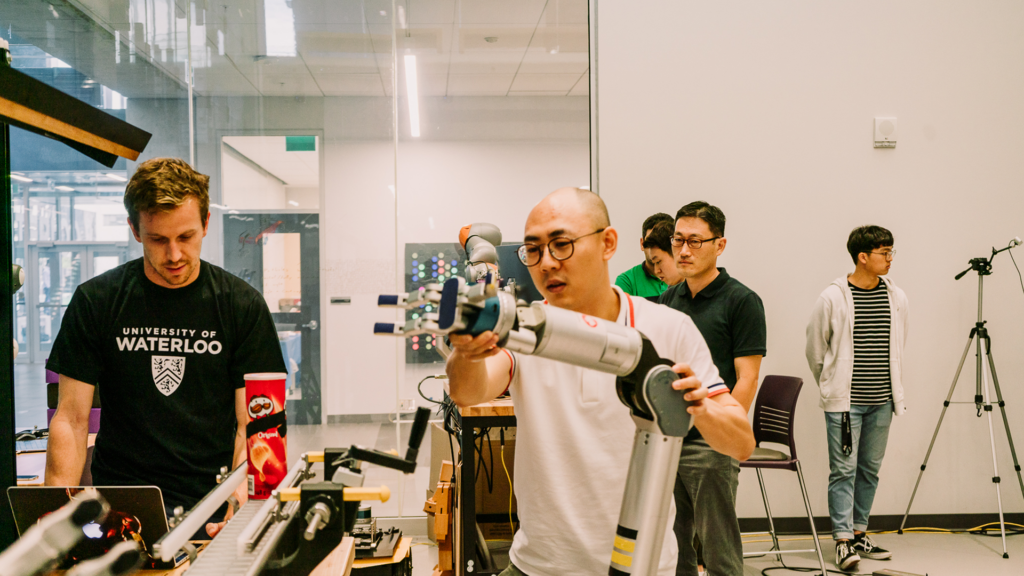
Students working with robotics at the University of Waterloo and the school’s RoboHub
Wilfrid Laurier University
Wilfrid Laurier University delivers on the software, AI and embedded-computing side of robotics innovation. Its technology-related program offerings build the foundational skills companies need for autonomous systems and intelligent machines. Here’s where that talent comes from:
- Software Engineering (Undergraduate): Laurier’s first-ever engineering degree, blending software engineering with physics and other disciplines and includes hands-on training in programming robots and building embedded systems
- Computer Science (Undergraduate): Builds algorithm analysis and design skills across procedural, object-oriented and low-level programming languages, with lab-based, hands-on coursework that gives graduates the technical foundation for automation-adjacent software roles
Conestoga College
Rockwell Automation’s VP of Robotics, Ryan Gariepy, explained the draw of the Waterloo community for robotics companies, in an interview with Waterloo EDC: “Machinists are here. Electricians are here. That’s very challenging to replicate elsewhere, like Tokyo or the Bay Area.”
Conestoga College plays a huge role in equipping our workforce with the skilled trades talent necessary for robotics operations. The polytechnic institution ensures that your company can find people to install, program, integrate, operate and maintain automation equipment and machinery—something you can only find in a community with a history of tech and manufacturing excellence.
Here are a handful of relevant program offerings at Conestoga:
- Mechanical Engineering Technology – Robotics and Automation (Diploma): Trains students in the control of robotic and automated equipment, covering 3D CAD, advanced robotics and Industry 4.0, culminating in a capstone manufacturing work cell project
- Manufacturing Engineering Technology – Welding and Robotics (Diploma): Trains students to operate and troubleshoot automated and robotic welding systems, including MIG welding, CNC thermal cutting and off-line robotic simulation
- Robotics and Industrial Automation (Certificate): Covers mechatronic applications, advanced robotics and industrial automation, culminating in a final-term automation project
- Mechanical Technician – General Machinist (Diploma): Prepares students for entry into the general machinist trade through computer-integrated manufacturing applications, covering all Level 1 and 2 outcomes of the related Ontario apprenticeship
- Electrician – Industrial (Apprenticeship): A 1,050-hour apprenticeship in the industrial electrical trade, covering motor controls, PLC fundamentals and automated control systems
"Machinists are here. Electricians are here. That’s very challenging to replicate elsewhere."
Ryan Gariepy
Vice President of Robotics, Rockwell Automation
Dive into robotics and automation in Waterloo