The short version
The business conversation – all over Canada – continues to be dominated by defence procurement. As a dual-use superstar, Waterloo continues to have a central role in that conversation.
Whether they’re talking about the many ways drone and robotics technologies can be adapted to future defence initiatives, or how operations can scale in the wake of monumental new defence investments, companies and business leaders from the Waterloo region have been vocal contributors to the discourse.
Read about these insights and more in our April Wrap-up.
Waterloo technology could reshape Canadian national security
Canada’s renewed commitment to investing in its military capabilities could be a boon to innovative dual-use tech companies in the Waterloo area. We build everything from robots and drones to next-gen watercraft and radar systems. In this fascinating article from the Waterloo Region Record, local leaders like Rockwell Automation’s Ryan Gariepy, Avidrone Aerospace’s Scott Gray, ENVGO’s Mike Peasgood and Maerospace’s Eric Meger provide insight into how the new national approach to defence is changing their industry.
Want more on Waterloo’s dual-use pivot? Check out our interview with Ruth Casselman, CEO of the Accelerator Centre and Co-chair of the new Waterloo Dual-Use Technology Consortium.
No to killer robots; yes to defence robots
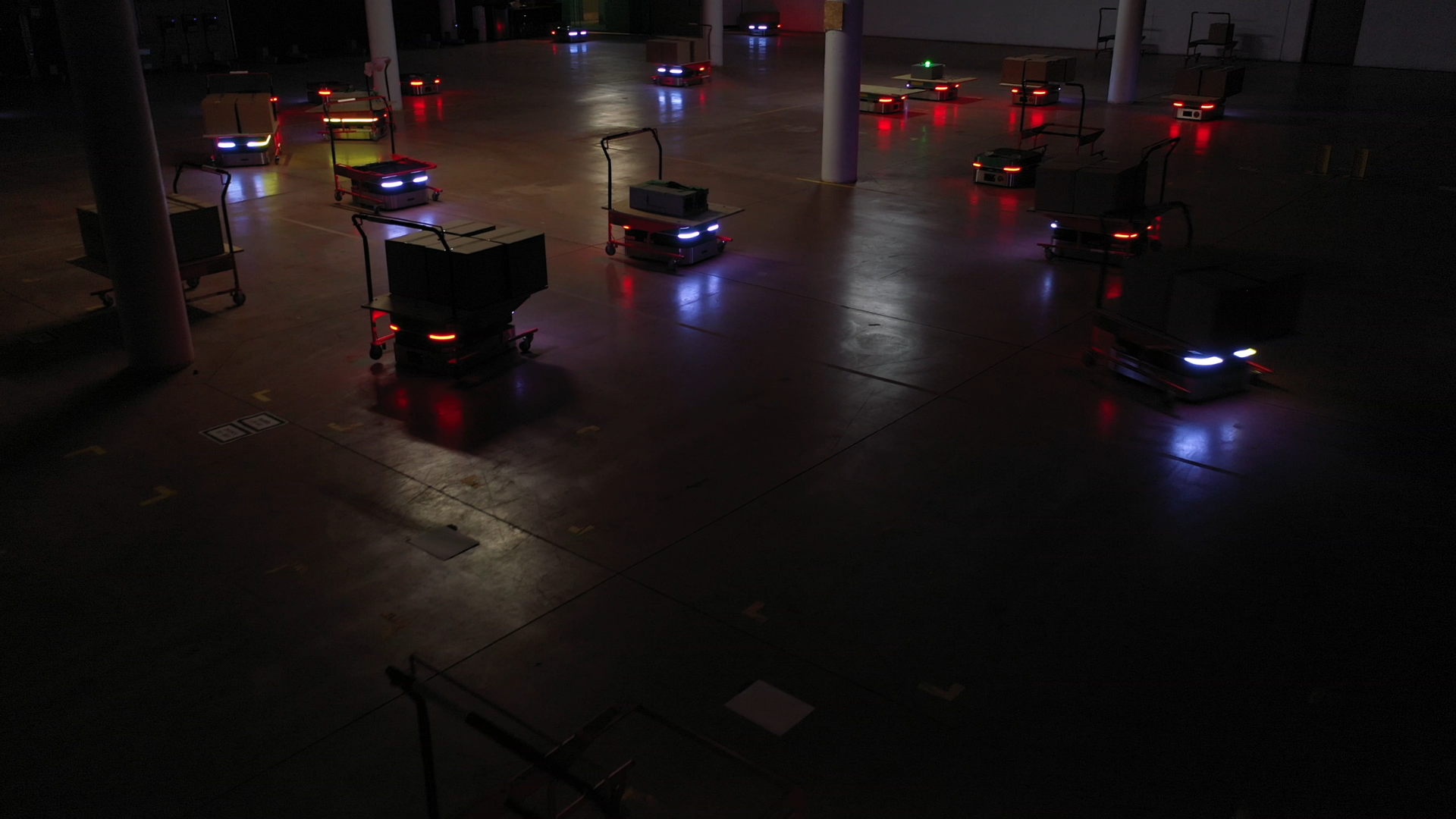
The massive leaps in robotics, drone technology and artificial intelligence have led to an ongoing debate about whether military robots should be able to apply lethal force. Rockwell Automation’s Ryan Gariepy doesn’t think it’s a great idea, but he does think robotics can play a key role in sovereignty and defence, especially in Canada.
“We’re a small country that does play on the global stage, which means that we will need force multipliers,” says Gariepy. Check out the full interview with Gariepy on Betakit to get more expert insight into the intersection of Canada’s Defence Industrial Strategy, robotics and artificial intelligence.
A roundtable on new Canadian military spending
Adding to the conversation about the potential for defence spending to radically re-shape the Waterloo tech ecosystem, the Waterloo Region Record produced a video roundtable discussion on the subject. Local experts, including Communitech’s Sheldon McCormick, the Accelerator Centre’s Ruth Casselman, Quantum Valley Ideas Lab’s Nick Werstiuk and Waterloo EDC’s Tony LaMantia weigh in on the challenge and the opportunity that comes with Canada’s renewed commitment to sovereignty and defence.
Waterloo technology has a future on the Moon
If humankind establishes a colony on the moon it’ll need water and power – luckily, the Canadian Strategic Missions Corporation (CSMC) is working on both. Fresh off winning the Canadian Space Agency’s competition to develop a lunar water purification technology, CSMC has been awarded $1.2M to build manufacturing capacity for its nuclear microreactor, which could power facilities in both the Arctic and on the Moon.
Learn more about CSMC’s newest innovations in the full article from Betakit.
More on Colt Canada’s new federal firearms contract
We’ve written a bit about Colt Canada’s new contract to supply the Canadian Armed Forces with up to 65,000 new service rifles, but this excellent new feature from the Waterloo Region Record explains how they were selected and what it means for the company’s long-term outlook. It also includes new details, including the fact that the order is expected to fully replace Canada’s existing military assault-rifle fleet, and that the order was followed by another for more than 50,000 rifles from Denmark’s military.
Mappedin raises $24.5M to meet a global opportunity
Waterloo navigation innovator Mappedin has mapped more than 10 billion square feet of indoor spaces across 86 countries, but this only accounts for 1% of the world’s indoor spaces. To map the remaining 99%, Mappedin has raised $24.5M to grow their client-base beyond shopping centres, airports and sporting venues.
“We believe Mappedin is uniquely positioned to become the de facto indoor mapping layer that powers digital experiences, operational intelligence, and safety systems across the built world,” says Ryan Ziegler of Edison Partners, one of Mappedin’s key investors.
There are big differences between Canadian and American energy
For manufacturers, energy costs and grid reliability can make or break a new investment’s viability. In one of Waterloo EDC’s newest articles, we break down the key differences between Canadian and American energy grids, including costs, reliability, cleanliness, policy environment and more.
Waterloo EDC searching for a new President & CEO
After ten years leading Waterloo EDC, Tony LaMantia will step down as President & CEO in 2026. To fill his substantial shoes, we’re looking for a relationship-focused leader with experience working with a wide range of stakeholders, including all levels of government, national and international business communities, academic institutions, the public and media.
Know someone who’d be the perfect fit? Direct them to the posting from executive search experts Boyden Canada.
Be the first to know
Don’t miss out. Subscribe to our blog to keep up with all the latest news and developments from Waterloo.