
The short version
Energy is one of the most important variables in any expansion decision, especially for manufacturers. In this piece, we compare Ontario and major US manufacturing states on their energy cost, reliability, emissions, transmission and policy risk and with an 84% emission-free grid, Waterloo comes out with one of North America’s cheapest and cleanest power.
For manufacturers weighing their next move, energy is a multifaceted calculation. How much will it cost? How reliable and clean is it? What happens if policy shifts? The answers vary significantly depending on where you decide to locate your company.
We break down the energy equation across five dimensions: cost, reliability, emissions, transmission capacity and policy risk. When applicable, we zoom in on Ontario’s energy grid and relevant manufacturing states in the US, such as Michigan and Ohio. Find out what location is best for manufacturers looking to fuel a successful future.
Key Takeaways
- Waterloo’s electricity rate of 6.15 US cents per kWh is among the lowest of major North American manufacturing markets
- Ontario’s grid produces 84% of its energy from emission-free sources
- Ontario’s centralized planning model through the IESO reduces policy uncertainty and supports long-term manufacturing investment
- Canada’s transmission infrastructure and cross-border interties make Ontario’s energy supply more resilient than fragmented US grid regions
Cheap energy
Where can you find the cheapest energy? We broke down the cost in US cents. Here are the current rates of energy cost per kWh in major manufacturing cities across North America.
Energy Cost per kWh in North America
- Waterloo: 6.15
- Detroit: 8.51
- Pittsburgh: 8.08
- Cincinnati: 7.37
- St. Louis: 9.65
- Indianapolis: 8.23
In addition to energy cost per kWh, Ontario offers lower carbon intensity than many US states, industrial programs that reduce corporate bills and province-level incentives that shift some of the cost away from ratepayers.
- The Industrial Conservation Initiative (ICI): Manufacturers in Ontario can significantly reduce their Global Adjustment (GA) costs by actively managing demand during peak hours. If you avoid consumption in the five highest demand hours of the day, the resulting reduction in system peak lowers the cost of generation in the longer term. Companies that have an average monthly peak demand of 5 MW are automatically deemed Class A consumers and are eligible for the ICI.
- Renewable Cost Shift: Large industrial users can tap into the Renewable Cost Shift program, which subsidizes the cost of legacy green energy contracts and reduces power costs for large industrial companies. It’s worth over $7 billion for industrial customers.
- Save on Energy for Industry: A suite of programs that provide incentives for on-site managers, energy management training and whole-building electricity savings, as well as support for custom conservation projects.
Reliable energy
Cost is only part of the equation. A discussion of energy costs is incomplete without factoring in grid reliability. According to the North American Electric Reliability Corporation, Canada’s overall track record for grid reliability is stronger than states across the US.
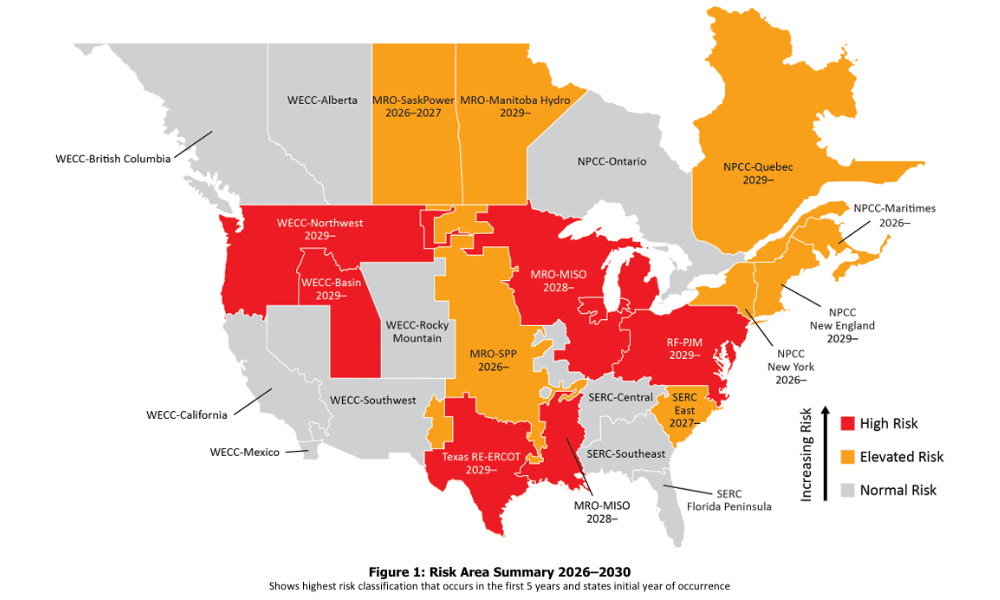
Source: “Long-Term Reliability Assessment,” North American Electric Reliability Corporation (2026)
Although both face similar challenges (rising demand, generator retirements and increasing weather disruptions), Canada has more centralized planning and a higher hydro and nuclear penetration—both of which contribute to a more reliable system.
Ontario has a centralized Independent Electricity System Operator (IESO) that forecasts demand, procures power contracts and runs demand-response programs years ahead. In contrast, the U.S. electricity system is split across multiple interconnections and many independent utilities, which makes long-term grid planning more fragmented and slower to coordinate. Currently, the IESO is undertaking new nuclear developments, long-duration storage and new electricity transmission projects to help meet increasing demand.
Additionally, Canada’s electricity mix of hydro and nuclear provides a steady, dispatchable energy output. In comparison, the US relies primarily on gas.
Clean energy
Speaking of clean energy output, Canada has one of the world’s cleanest energy grids, produced mostly from zero-carbon sources like nuclear and hydro. A small percentage is produced from solar and wind energy. Nuclear is not explicitly considered “clean energy,” but it is emission-free and generally considered a greener option than coal or natural gas.
The US grid is more dependent on fossil fuels. With a much larger group of power plants burning fuel, the US has a higher carbon intensity and isn’t as attractive for companies looking to cut or eliminate their emissions. To be fair, some states are cleaner than others. California and Oregon, for instance, are less dependent on fossil fuels than coal-heavy regions like Ohio, Kentucky and West Virginia, but those cleaner states tend to be significantly more expensive. On the whole, Canada’s energy grid is substantially cleaner than those across the US.
Here are the current percentages of emission-free energy in manufacturing-city grids across North America.
% of Emission-Free Energy in North America
- Waterloo: 84.30%
- Detroit: 32.47%
- Pittsburgh: 34.68%
- Cincinnati: 17.93%
- Louis: 27.47%
- Indianapolis: 14.78%
It’s worth noting that both Canada and the US are investing in small modular reactors (SMRs), with first units aimed for deployment within the next 10 years. These new nuclear developments will be critical to energy calculations for expanding manufacturing companies in the years to come.
Energy transmission
There are 31 transmission connections (interties) between the US and Canada. Every Canadian province that shares a border with the US has at least one transmission interconnection. Ontario and Quebec have the most, three apiece.
As a result, Ontario’s border interties create useful redundancy and reliable trading options. Michigan also benefits from these connections, but several other states across the US don’t reap the rewards of cross-border support. In these other states, the transmission system is larger and more fragmented, leading to regional bottlenecks. Michigan and Ohio both have denser transmission networks, but face challenges with growth, fragmented planning and bottlenecks. Texas has its own completely independent power grid, which caused significant reliability issues during the 2021 Texas power crisis.
With its centralized control, the Ontario government is expanding energy infrastructure, building two new transmission lines and completing two major transmission upgrades in the coming years.
Policy and investment risk
Policy and investment risk influence manufacturers’ access to energy. Stability and long-term planning keep energy cheaper, greener and more reliable, reducing shocks to the system. Canada is emerging as a beacon of economic and political stability, creating an environment in which companies can invest more confidently. Canada is simply more predictable.
The IESO is responsible for planning supply and managing the energy market in Ontario, introducing programs and policies to reduce costs, like General Adjustment (GA). Since the IESO is the only electricity planning network in Ontario, manufacturers deal with a single set of rules, rather than a patchwork of policies.
Energy policies in the US are fragmented across utilities, regulators and market regions, since most states rely on ad hoc tax packages and utility-specific programs. Policies are less centralized, leading to increased uncertainty for the utility and region.
More broadly, Canada is a stable place to conduct manufacturing business. Unlike the US, we have several multilateral trade agreements, notably with the European Union, Japan, Singapore, Vietnam and the United Kingdom. One of our current government’s priorities is to establish new international partnerships, deepening Canada’s access to suppliers, markets and consumers.
Cheap, clean and cheerful
Canada offers a smart energy strategy, especially at a time when the world is reflecting on its energy usage, sourcing and consumption. You can find the solution to your energy equation in the Waterloo region, where energy is less expensive, reliable and cleaner. Here, you can take advantage of the stability and predictability of the IESO’s planning and Canada’s multilateral trade agreements.
Thinking about expanding your manufacturing operations?
Waterloo EDC can help you understand the full picture, from energy costs to site selection.