The short version
Following the launch of Canada’s first-ever Defence Industrial Strategy, national and international attention is turning to those regions that can translate policy into real innovation. Waterloo is at the forefront of embracing this opportunity to turn its tech capabilities into real impact for Canada and its allies.
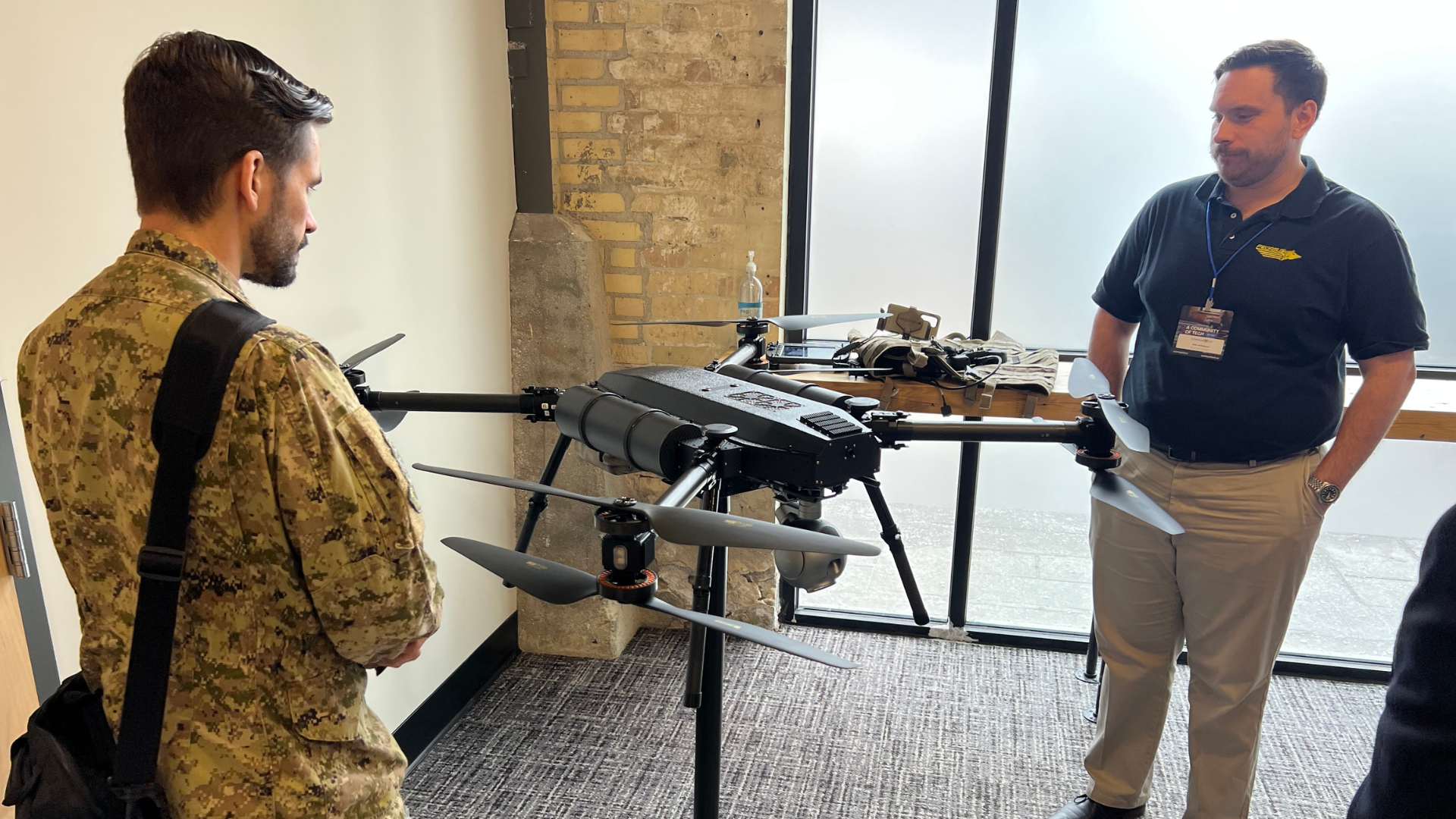
Central to the discussion of defence innovation is the concept of dual-use technologies – products or solutions that work in a commercial setting but also have applications in a defence or military context. This can include technologies like robotics, advanced materials, drone systems, AI and cybersecurity solutions.
“The product is the same,” Ruth Casselman, CEO of the Accelerator Centre and Co-chair of the new Waterloo Dual-Use Technology Consortium. “There may be some adaptations for defence, but the core technology doesn’t change.”
Many of those core technologies are currently built in the Waterloo region.
Key Takeaways
- Waterloo is ready to lead in dual-use innovation, with strong capabilities in AI, robotics, quantum and cybersecurity – and backed by a powerful ecosystem
- Dual-use tech enables companies to adapt existing commercial technologies for defence applications and unlock new revenue streams without starting from scratch
- The Waterloo Dual-Use Technology Consortium is strengthening the ecosystem by connecting companies to peers, government support and global market opportunities
Why Waterloo is poised to lead on dual-use technology
It helps that Waterloo’s longtime strengths – in dual-use darlings like robotics, quantum and cybersecurity – align so nicely with the needs of the defence industry. However, it takes more than an existing business community to drive dual-use innovation.
“We have world-class universities, strong talent pipeline in tech and manufacturing and a robust ecosystem that supports companies at every stage of growth with organizations like Communitech, Velocity and the Accelerator Centre,” says Casselman. “While we are known as a tech hub, we also have a long history of manufacturing expertise.”
It’s this combination of talent, research capabilities, commercialization support and innovative mindset that sets Waterloo apart.
“It’s hard to predict where the technology will go in the next few years. But what I can say with confidence is that our community has consistently shown its ability to innovate and adapt to what’s next,” says Casselman. “I’m excited for the future knowing that Waterloo region will keep doing what we always do – putting really smart people on really hard problems and come up with great solutions.”
A new player in the Waterloo defence and dual-use ecosystem
A new player in the Waterloo ecosystem, the Waterloo Dual-Use Technology Consortium emerged organically in response to a clear need in the community.
“We had a few companies working at the Accelerator Centre in the defence space approach us with a simple ask: they wanted a space to connect with other defence-related businesses navigating similar challenges,” says Casselman.
They brought together eight companies from around the region to discuss the opportunities and challenges and realized that while Waterloo had incredible companies doing exciting work in the dual use space, they were each trying to navigate commercialization, market access and visibility on their own.
They brought together more players – the Region of Waterloo, Communitech and AeroWR among them – to expand the conversation. The group now includes 50+ companies, too.
How the Waterloo Dual-Use Technology Consortium helps
“Defence is a complex space. There are regulations, procurement processes and specific requirements that companies need to navigate,” says Casselman. “With the help of this consortium, we’re creating both peer support and a unified platform to showcase what our community can offer.”
The Waterloo Dual-Use Technology Consortium offers three things. First, monthly peer-support meetings where members discuss collaboration opportunities and challenges to foster shared learning. Second, stronger connections with government organizations that provide funding, guidance and support. Third, the consortium creates opportunities for companies to engage directly with policymakers and potential buyers.
“But most importantly, we are helping put [the] Waterloo region on the map as a hub for dual-use innovation.”
A shifting landscape for defence and dual-use opportunity
It’s hard to overstate how much the business landscape has changed for Canada-based defence and dual-use companies over the last year.
Tariffs reduced exports and created pressure to find ways to support businesses operating in Canada. International pressure has pushed Canada to adopt significantly higher targets for defence spending. National priorities – including defending the Arctic against increasingly aggressive Chinese and Russian influence – require smart, cost-effective and innovative solutions.
Together, these factors produced a perfect storm for the creation of the Defence Industrial Strategy, which has real implications for companies in Canada and those that might want to come here.
The new Strategy the driving force behind the push for dual-use technology innovation, but is also reflected in the rapid evolution of the Waterloo region aerospace and defence sector, where innovation is increasingly driven by commercial and strategic purposes.
“For perhaps the first time in many years, Canadian companies are being actively called upon to contribute to national defence solutions. It’s a real honour to be part of this national momentum,” says Casselman. “At the same time, it’s a great time for international businesses to invest in an ecosystem that has policy support and the right capabilities.”
“It’s an opportunity to build technologies that not only drive business growth, but also help protect our people, data and infrastructure – and support our allies globally.”
Find your place in the new era of dual-use innovation