The short version
What does it take to become a global nuclear energy leader? Canada is well-positioned to find out.
A sweeping new federal Nuclear Energy Strategy with a focus on energy sovereignty is set to power Canada’s economy and expand its energy grid into the next decade.
Nuclear energy is rapidly becoming a cornerstone of economic security, affordability and sovereignty. Canada’s Nuclear Energy Strategy is designed to ensure Canadians have access to clean, affordable and reliable power while seizing a global nuclear market expected to grow by up to $200B per year by 2030.
Key Takeaways
- Canada’s Nuclear Energy Strategy targets a global nuclear market expected to reach $200 billion annually by 2030
- The federal government is investing $40M to study nuclear microreactors for Arctic military facilities
- With two global nuclear leaders, BWXT and Westinghouse, located in the Waterloo region, our community is poised to play an important role in Canada’s nuclear future
Canada’s existing energy leadership
Canada is already an energy superpower. Right now, nuclear generates approximately 13% of the country’s electricity, the sector contributes $22 billion annually to the economy and Canada supplied roughly 24% of global uranium output in 2024.
Our nuclear innovations are world-class, too. Homegrown CANDU (CANada Deuterium Uranium) reactors, a natural uranium-fueled and Canada-designed technology, are recognized globally for their reliability and efficiency. We’ve exported these reactors around the world; they are in operation in Argentina, China, India, Pakistan, Romania and South Korea.
Canada is also ahead of the curve on Small Modular Reactors (SMR). We’re currently on track to become the first G7 nation to deploy a SMR, which is a nuclear reactor that produces up an output that is a third, or a quarter, of the output produced by a traditional large nuclear power plant. The SMR is at the Darlington Nuclear site in Ontario, which is one of Canada’s leading province when it comes to nuclear—almost 50% of our energy is generated by nuclear.
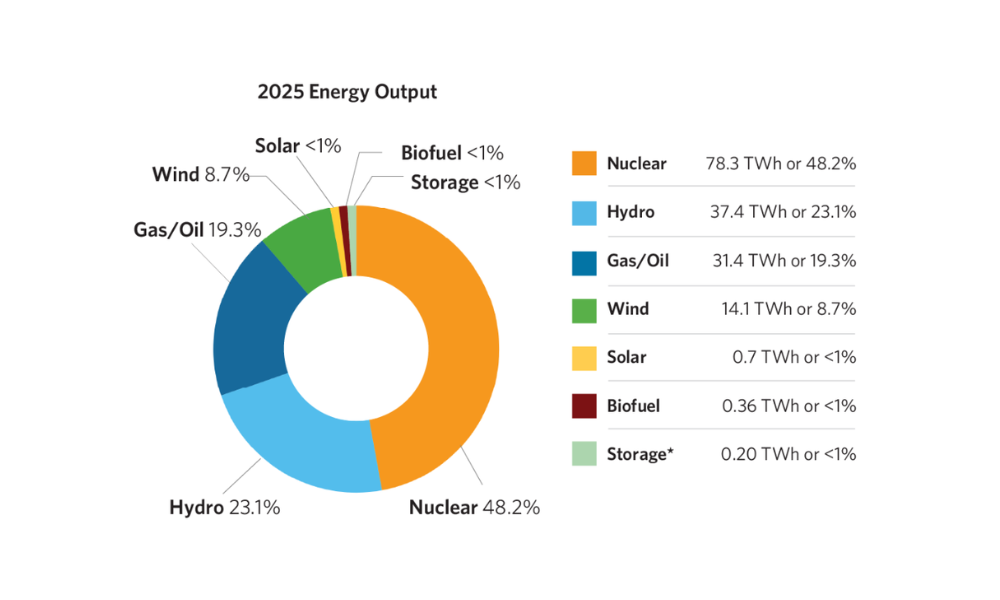
Source: “Yearly Energy Output by Fuel Type.” IESO, 2025
How the strategy builds on our strengths
The strategy aims to boost our existing nuclear capacity through four pillars:
- Enabling new reactor builds across Canada
- Becoming a global supplier and exporter of choice
- Expanding uranium production and nuclear fuel opportunities
- Developing new Canadian nuclear innovations, including fission and fusion
Microreactors are on the front line
Alongside the broader strategy, the Department of National Defence is investing $40M to study the feasibility of deploying Canadian-controlled microreactors at remote military facilities in the Arctic. Microreactors are compact systems producing less than 20 megawatts, small enough to be transported by truck and potentially mass-produced in factories. For remote military applications, they offer a consistent energy source that doesn’t depend on diesel resupply chains, which is a critical advantage as Canada modernizes its Arctic infrastructure.
Several Canadian companies are already developing microreactor technology with northern deployment in mind:
- Canadian Strategic Missions Corporation (Waterloo) recently secured $1.2M through NGen’s Advanced Manufacturing Technology Program to develop an in-factory manufacturing cell for its Low Enriched Uranium Nuclear Reactor (LEUNR) microreactors
- Boreal Energy Systems (Ottawa) is developing a one-megawatt Micro Modular Reactor targeted at defence missions in the Arctic and infrastructure for the North American Aerospace Defence Command (NORAD)
- Prodigy Clean Energy Ltd. (Montreal) is developing a vessel called the Transportable Nuclear Power Plant that will facilitate the deployment of reactors in the North, with a $2.75M investment from the federal government
Why this points to Waterloo
As Canada’s nuclear sector scales, questions arise: who will build the components, train the workforce and anchor the supply chain?
With our strategic location, existing nuclear capacity and multidimensional workforce, the Waterloo region is well-prepared to support Canada’s push for cleaner, more secure energy. It’s why two of the world’s leading nuclear companies, BWXT and Westinghouse, have already invested here to build CANDU technology and support the development of microreactors.
“Canada’s Nuclear Energy Strategy creates enormous opportunity, and Waterloo is not starting from scratch. We have the talent, the supply chain and the proven track record to be a central player in Canada’s nuclear future,” says Erin D’Alessandro, Vice President of Business Development at Waterloo EDC.
BWXT leading CANDU development with local operations
BWXT Canada has been a cornerstone of Ontario’s nuclear industry for over a century, helping to build one of the world’s greenest power grids. Headquartered in Cambridge, part of the Waterloo region, its facility is one of North America’s leading commercial nuclear manufacturing plants, with more than 800 employees producing components including over 300 steam generators.
In 2024, BWXT announced an $80-million expansion: $50 million to grow the Cambridge facility by 25% and add 200+ long-term jobs, and $30 million to establish an additional 150,000-sq.ft. advanced training and innovation facility in the region, focusing on CANDU technology development.

BWXT’s headquarters
Westinghouse designing microreactors from Waterloo
Westinghouse Electric Company opened its global nuclear engineering hub in Kitchener in 2024, drawn by our community’s deep engineering talent pipeline and proximity to Canada’s two largest nuclear power plants (Darlington Nuclear and Bruce Nuclear Generating Stations, the latter among the largest operating nuclear generating stations in the world).
The hub’s global design engineering teams are dedicated to supporting the CANDU operating fleet, as well as the global deployment of new build technologies, including advanced small modular reactors and the microreactors that will fortify the Arctic.

Westinghouse’s engineering hub
Canada’s Nuclear Energy Strategy is a generational commitment to clean energy leadership and made-in-Canada innovation. For companies evaluating where to invest within that supply chain, Waterloo already has the answer: a proven nuclear industrial base, world-class engineering talent and two of the world’s leading nuclear companies already growing here.
Discover the energy differences between Canada and the US
For manufacturers looking to expand, energy is a top consideration. Learn more about the big differences between energy grids in the US vs. those in Canada.