The short version
Ontario is at the heart of the nuclear revolution. More than 50% of our power generation is from nuclear, making it emissions-free, reliable and central to our sovereignty. Major federal funding, procurement opportunities and long contracts for supply chain companies are coming down the pipeline. To capitalize on the opportunity, you need to be in Ontario.
Energy is evolving, and nuclear is eclipsing fossil fuels as the leading choice. Not that there is much of a choice—the global environment and economy demand new ways of generating power. Nuclear, and the electricity it generates, is now “being recognized as a foundational economic innovation, job-creating, climate-achieving and national security asset,” according to George Christidis, president and chief executive officer of the Canadian Nuclear Association.
Here in Canada and Ontario, we don’t hesitate to do something new: Canada was the first G7 nation to break ground on a Small Modular Reactor (SMR), and Ontario Power Generation’s (OPG) Darlington plant is the world’s largest completed nuclear refurbishment. Homegrown nuclear innovation, like Canada Deuterium Uranium (CANDU) technology, supports the industry and capitalizes on Canada’s uranium production.
Nuclear energy has major investment potential. If you want to understand the industry and opportunities in Ontario, you’re in the right place. Here’s what you need to know.
What Ontario generates
Two main players anchor Ontario’s nuclear ecosystem: OPG and Bruce Power. OPG is an Ontario-owned Crown corporation and produces approximately half of Ontario’s electricity. Bruce Power is a privately-owned Canadian partnership and one of Canada’s largest private investors in critical infrastructure.
They operate three nuclear power plants: Bruce, Darlington and Pickering Generating Stations. Together, the stations generate 12,000+ MW of nuclear capacity, which makes Ontario North America’s largest nuclear jurisdiction by capacity.
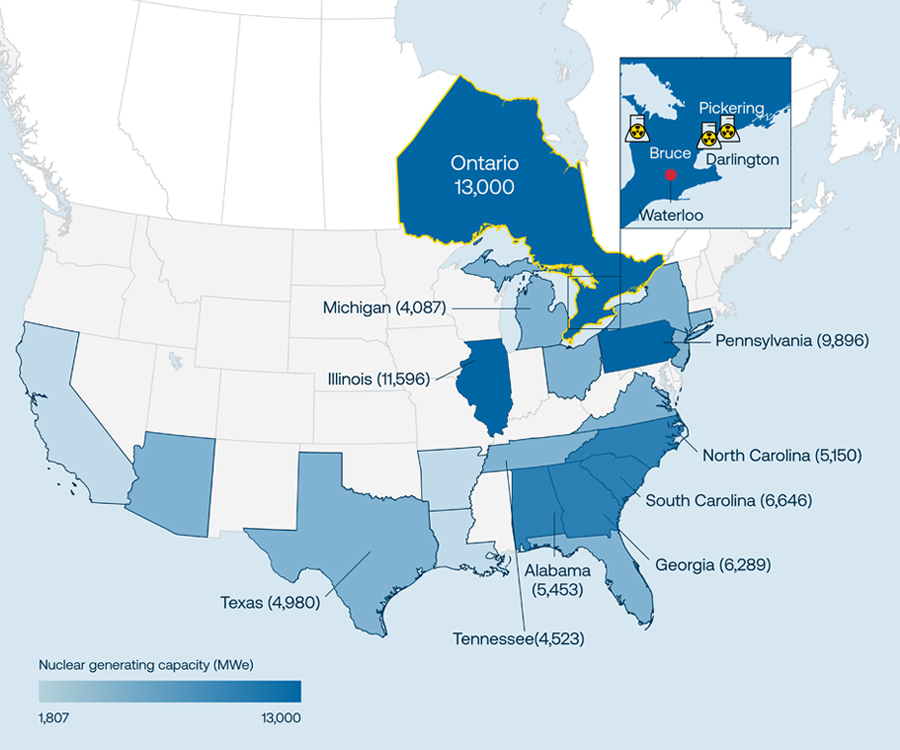
North America’s Nuclear Heat Map (Sources: US Energy Information Administration; Independent Electricity System Operator)
Plus, two proposed nuclear projects at Bruce Power and OPG would add 14,800 MW of nuclear generating capacity, if given the go-ahead. Wesleyville, located between the Pickering and Darlington plants along Lake Ontario, is set to generate 10,000 MW of capacity and designed to operate for 78 years. Bruce C will be part of the existing Bruce Power plant in Kincardine, providing 4,800 MW to power millions of homes and businesses across the province. Both are undergoing federal impact assessments to ensure environmental and social safety.
This power helps Canada avoid significant carbon emissions each year and presents land-use benefits: OPG reports that to generate 300 MW of energy, “solar would require about 100 times and wind about 500 times more land area [as nuclear].”
Developments are also accumulating at existing plants. Darlington is building the G7’s first grid-scale SMR project. These reactors will be tied to Ontario’s power grid. The established nuclear facility is the perfect place to pioneer SMR production because OPG has the existing infrastructure, proximity to the main grid, nuclear supply chain and, frankly, the money to complete it. The project is creating 18,000 jobs during construction and 3,700 during operation, contributing $38.5B to Canada’s GDP over its 65-year lifespan.
How nuclear is funded
Nuclear is emerging as a critical investment priority, opening the door for more federal and provincial funding. Energy sovereignty, climate change and electricity demand are driving the investments.
Here are some of the recent funding announcements:
- The Canada Growth Fund committed $2B to support the construction and operation of Darlington’s SMR project
- The Ontario government is supplying an additional $1B to Darlington
- Ontario announced a $1.9M investment to strengthen its nuclear supply chain, preparing workers and businesses for major upcoming nuclear projects
- As part of the new federal Nuclear Energy Strategy, the federal government is deploying $40M to study nuclear microreactors for Arctic military facilities
- Canada is also financing $2.2B over 10 years in capital investments at Chalk River Laboratories, Canada’s national nuclear labs
- The two additional projects under consideration—Bruce C and Wesleyville—could push total nuclear spending above $100B in the long term
What procurement opportunities are available
Ontario is using nuclear procurement, major refurbishment projects and new-build programs to deepen its domestic supply chain. In 2025, Bruce Power reported that 95% of its spending remains in Canada, including operations, capital investments and procurement.
An Ontario presence can be commercially advantageous, helping companies collaborate with OPG and Bruce Power. Companies can participate by establishing credible Canadian capacity, meeting utility qualification requirements and creating measurable local economic value.
And since there’s a comprehensive nuclear ecosystem in Ontario, there are procurement opportunities beyond Bruce Power and OPG. Your company can work with refurbishment contractors, Canadian nuclear suppliers, research institutions and more.
Plus, supply chain companies in Ontario can earn cross-border benefits. Ontario recently signed Memoranda of Understanding (MOUs) with the states of New York and Pennsylvania to share expertise, expand cross-border energy trade and collaborate on nuclear workforce initiatives. Our continued leadership in nuclear energy undergirds these agreements, allowing supply chain companies in Ontario to integrate into American energy markets, too.
Why long contracts bolster the supply chain
The longevity of these procurement contracts highlights Ontario’s investment potential for international nuclear and nuclear-capable companies considering expansion. Nuclear anchors Ontario’s long-term electricity strategy, and life-extension work is underway at both Bruce Power and OPG. This generates long-term demand across engineering, manufacturing, construction, maintenance, digital systems and professional services. For example, the SMR project at Darlington is expected to take 10 years, and the government is investing $60 to $100B over the next 20 years for additional nuclear infrastructure across the province.
Considering the relationship between nuclear and AI
We’d be remiss not to mention the budding relationship between nuclear and AI, which contributes to the nuclear resurgence. The Harvard Business Review reports: “AI requires a huge amount of computation, and that computation demands a lot more electricity than previous web-based technologies.” Energy demands are skyrocketing, and the technology industry’s increased need for power is imminent.
Nuclear can provide carbon-free baseload deep into the future, which is essential for AI data centres. Companies like Google, Microsoft and Amazon are signing agreements with conventional nuclear power producers and advanced nuclear technology companies. Opportunities for funding, procurement, innovation and IP are emerging from the interdependent relationship between AI and nuclear.
Entering the next phase of nuclear
Nuclear energy is inextricably tied to economic growth and environmental protection. These projects have long-term, generational impacts locally, nationally and globally. Investing in nuclear means investing in an industry with a future.
Where does Waterloo fit in? The opportunity in our community is bigger than clean power generation; it’s about the technology and manufacturing expertise, and engineering and skilled trades talent, that enable the province’s billion-dollar nuclear sector.
Nuclear expansions in Waterloo
Global companies with bold ambitions and long-term growth strategies are choosing Waterloo for energy projects. Is your company next?