
Where should a tech company look to expand in North America? To answer the question, we’ve compared five fast-growing tech ecosystems – Austin, Columbus, Detroit, Pittsburgh and Waterloo. Data points include time zone, workforce size and growth, talent market rankings, university rankings and costs. Spoiler alert: Waterloo is competitive – or the top dog – across all five metrics.
Not all tech hubs are created equally. They have different strengths and weaknesses that may or may not optimize your business growth. To find out which is which, we can look at key metrics, like strategic location, access to talent and business costs.
When comparing tech hubs in North America, it makes sense to remove larger communities like New York, Silicon Valley and Toronto. They simply operate on a different scale and come with their own unique benefits and costs. Besides, most tech leaders already know what they offer.
For companies looking to expand their operations to North American locations, some of the best growth opportunities are in mid-sized markets. While they’re smaller in scale than the giants, they provide access to new talent pools, specialized expertise, stronger cost-to-value advantages and often a tighter-knit community that offers greater opportunities for collaboration, connection and innovation.
Whether you’re a European company looking to enter North American Markets or an American company considering expansion into a mid-sized hub, understanding how these markets compare is critical. To help you identify the best fit for your company, we’ve compiled a list of useful statistics and sources that compare similarly sized North American hubs across important business metrics, while also including European examples for additional context.
Key Takeaways
- Time zone, strategic location, tech talent pool, and emerging talent should all be central considerations for companies expanding in North America.
- Third-party reports, like CBRE’s Scoring Tech Talent, are an invaluable source of reliable information for expanding companies.
- Tools like the Waterloo EDC Tech Talent Calculator can help build a business plan, especially when they are based on reliable, comparable and third-party data.
- Across all these metrics, Waterloo proves to be a very competitive location for growing tech companies, especially for those coming from Europe.
Strategic location means market access and corporate coordination
Strategic location for tech companies isn’t the same as strategic location for consumer-packaged goods or advanced manufacturing. It’s not about access to consumers, suppliers or OEMs. For tech, strategic location is about access to talent, ecosystems and expertise.
In that sense, Waterloo and these other tech hubs share similar advantages. They all have substantial existing talent pools, ecosystems with a reputation for innovation and universities with deep research strength. What makes Waterloo region an outlier is its proximity to Toronto’s scale – it’s able to give companies access to a larger talent pool and market.
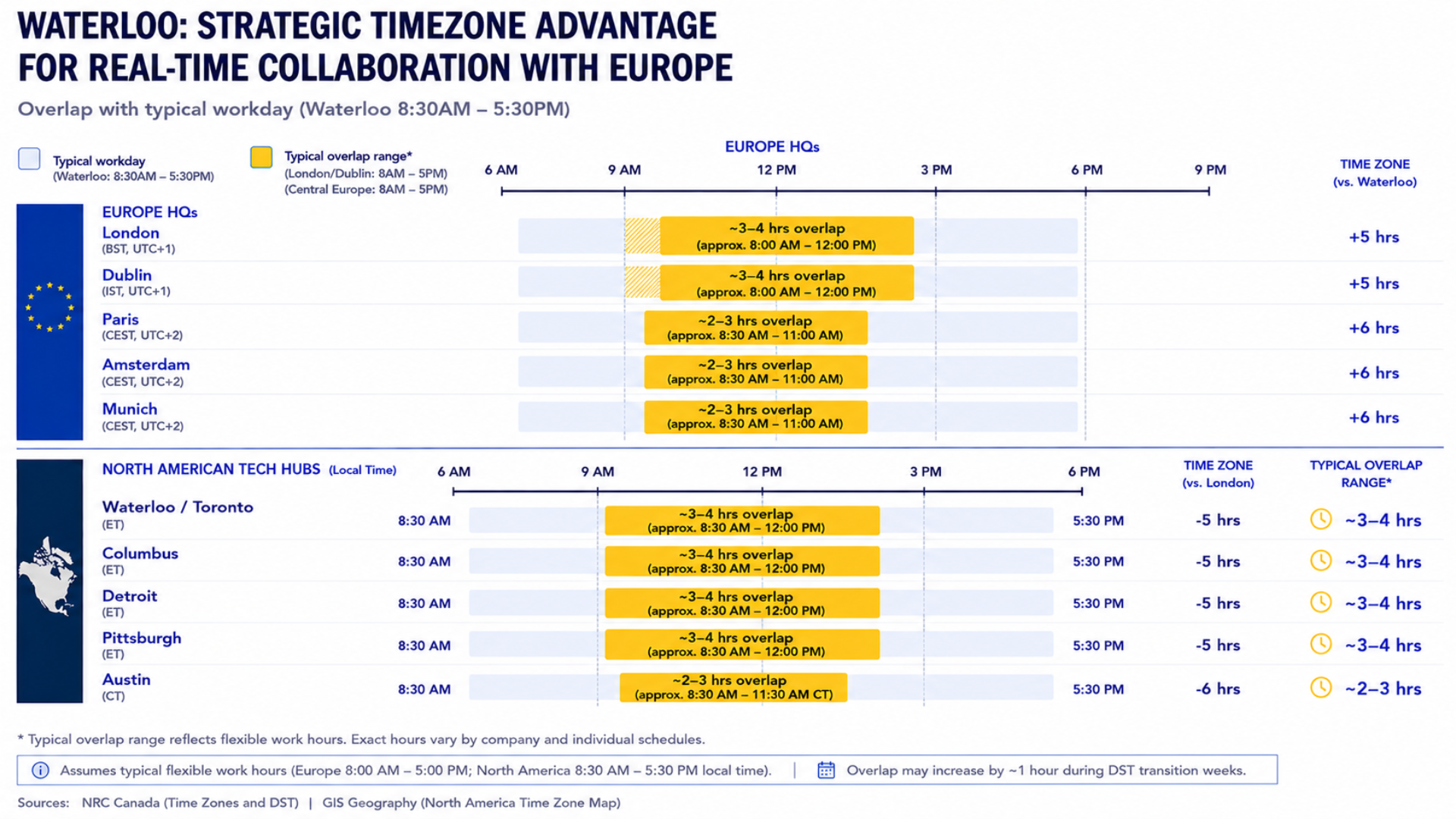
Source: Times shown reflect Daylight Saving Time (DST) when in effect; NRC Canada; GIS Geography
Time zones might seem like a small detail, but they have a big impact on how teams collaborate day-to-day. For North American companies, there can be benefits to keeping all your locations within the same time-zone: everyone’s working the same hours. For European companies expanding into North America, the issue becomes more serious: how many core hours will your new location share with the existing HQ?
This is where hubs in the Eastern Time Zone are helpful. They share 3-4 working hours with much of Europe – a typical morning in Eastern Standard Time lines up with the afternoon in cities like London, Paris and Berlin – giving teams a window to meet each day and sync up.
Tech workforce size and growth trends
Source: CBRE Scoring Tech Talent Report 2025
A strong, expanding workforce fuels innovation, supports scalable growth and gives companies the agility to adapt to rapid industry change.
Strong workforce growth in a mid-sized hub usually means it can attract and retain talent, thanks to good schools, established companies and a higher quality of life compared to larger cities. High talent concentration indicates how central the tech industry is to a community’s economy.
In this category, there is a clear standout. The Waterloo region leads comparable hubs with the highest tech talent concentration (11.7%) and workforce growth (58.2%), while others report lower concentrations and slower, even negative growth.
If there’s one criticism of Waterloo, it’s that the overall workforce size isn’t huge – in fact, it’s much smaller than Austin or Detroit. However, it does have access to more than 373,000 tech workers from across the Toronto-Waterloo Corridor, which is a big advantage you won’t find elsewhere.
" The top priority we hear - from every tech company we talk to about expansion - is talent. "
Erin D’Alessandro
Vice President, Business Development, Waterloo EDC
Post-secondary institution rankings
*Universities marked with an asterisk do not provide full enrollment numbers for their Computer Science programs, but they do provide either enrollments in the past year or total number of graduates from a given program. This will not provide a perfect reflection of enrollment, but it does not affect this article’s conclusions. We’ve included European institutions for comparative value.
Growing tech companies need access to strong talent pools. That’s not just about having top-ranked universities nearby—it’s also about scale. Larger programs produce more graduates, which makes hiring more practical over time.
QS rankings compare universities on factors like academic reputation, employer perception, research output, teaching capacity and international presence. For companies, these rankings can be a useful starting point when evaluating new markets, as higher-ranked schools are generally associated with well-regarded programs and skilled graduates.
That said, rankings don’t tell the whole story. Enrollment size is a key statistic. Some highly ranked programs graduate relatively smaller cohorts, which makes it difficult for companies when they are recruiting. In contrast, a successful computer science program with a larger cohort of students offers a better chance at recruitment.
Looking at enrollment data, the University of Waterloo, ranked 27th on the QS scale, has one of the largest computer science cohorts at around 4,932 students. It is followed by the Technical University of Munich, ranked 26th, with approximately 2,765 students. The data also shows that several top-ranked institutions in the comparison—such as Carnegie Mellon University and the University of Oxford—have smaller class sizes. This highlights a common trade-off between program ranking and the size of the available candidate pool.
Talent market rankings and third-party reports
Population growth from 2018-2023 at the CD/MSA level; CBRE Scoring Tech Talent Report 2025
Third-party reports are a useful and reliable source for understanding an ecosystem’s strengths and weaknesses. CBRE’s annual Scoring Tech Talent Report and Startup Genome’s Global Startup Ecosystem Report are two premier examples. They create a snapshot of each market by looking at factors like talent pipeline, diversity, population growth, employability in tech and office rent.
The data above is from the CBRE report and you can see its usefulness in getting an initial, high-level understanding of how these communities compare.
Workforce diversity is relatively consistent across all cities (roughly 22%-29%), showing that each market draws from a broad talent pool. Rent costs are also generally within a comparable range, although Austin stands out as having significantly higher rent. If cost is a concern, that key stat might help make your decision.
The biggest differences appear in the working-age population growth. Columbus, Detroit and Pittsburgh, all saw declines in their 20-30-year-old population over the last five years while Austin recorded a modest growth of 7.8%. Waterloo stands out with a much stronger growth rate, at 40.3%. A similar trend appears in the 30–40 age group. This sort of snapshot provides immediate insight into whether an ecosystem is on the rise, or plateauing.
Estimated annual tech talent costs across North American hubs
Source: Tech Talent Calculator, Waterloo EDC
When evaluating new locations for expansion, cost is often one of the biggest factors in the decision-making process. To help provide an objective comparison of tech talent hiring costs between Waterloo and other North American hubs, Waterloo EDC developed the Tech Talent Cost Calculator.
This tool allows you to build a sample team using 27 common tech roles, adjust the number of hires and see an estimate of annual hiring costs. You can also see the breakdown of the cost into elements like salary, payroll taxes, insurance and other employer expenses.
For example, based on a sample team of 25 employees across a mix of roles, each with five years of experience, the data shows that Waterloo has comparatively lower tech talent costs. While salaries are broadly comparable across Austin, Detroit, Columbus, Pittsburgh and Waterloo, lower payroll taxes and a favourable exchange rate help keep overall hiring costs down in Waterloo.
Of course, actual costs will vary depending on the size and makeup of your team. The calculator is designed to help you explore different hiring scenarios and get a more tailored estimate of what tech talent costs might look like for your team across North American locations.
Overall, the data makes a strong case for Waterloo. Strategic location, population growth and diversity, trained talent, top-ranked post-secondary institutions and highly competitive operating costs help Waterloo stand out as a uniquely balanced and future-oriented choice for business expansion.
Check out our Tech Talent Calculator, which helps you calculate cost savings and the total cost of talent from building your team in Waterloo compared to other cities in North America.