The short version
Technology, manufacturing and engineering talent enable Waterloo’s energy sector to fuel the next generation of emission-free power. It’s a multifaceted talent pool that works together to develop and deploy sustainable solutions for our warming planet.
Some industries are complicated.
When we talk about energy, we’re talking about nuclear, batteries, alternative fuels, electrification, storage and clean technologies. We know. It’s a huge spectrum. How do you possibly map that range of talent?
We’ve focused on three key areas: nuclear, batteries and cleantech. Our post-secondary schools rise to the challenge of equipping students with the skills they need to make a difference in this dynamic field and its subsectors, as highlighted below.
Take a look at the programs at the University of Waterloo, Wilfrid Laurier University and Conestoga College connected to the clean energy industry.
Key Takeaways
- The University of Waterloo trains clean energy talent through nine programs spanning environmental, chemical, electrical and nuclear engineering, supported by research hubs like the Waterloo Institute for Sustainable Energy and the Ontario Battery and Electrochemistry Research Centre
- Wilfrid Laurier University produces graduates skilled in environmental policy, geospatial analysis and sustainability, ready to guide the energy sector’s data and tech direction
- Conestoga College’s School of Trades and Apprenticeships, the largest of its kind in Canada, equips students with the electrical, welding and mechanical skills that power the systems on which nuclear manufacturers rely
University of Waterloo
The University of Waterloo (UWaterloo) generates talent for the energy industry in the Waterloo region, with programs spanning every major engineering discipline, from mechanical and materials to nanoscale and nuclear.
The school is home to a host of related research hubs, such as the Waterloo Institute for Sustainable Energy (WISE), Fuel Cell and Green Energy Lab, Applied Nanomaterials and Clean Energy Laboratory and Ontario Battery and Electrochemistry Research Centre. The latter is a one-of-a-kind battery research hub engaged in groundbreaking research, where students can earn hands-on battery innovation experience alongside faculty.
Whether you’re looking for nuclear talent or battery experts, UWaterloo’s clean energy programs have you covered:
- Environmental Engineering (Undergraduate): Trains students to design water treatment systems, model air quality and build energy sustainability solutions, merging math and physics with biology and chemistry to tackle problems at the intersection of engineered and natural systems
- Civil Engineering (Undergraduate): Large-scale infrastructure design, from transportation networks to municipal water systems, makes up the core of this degree, preparing engineers to build smart, sustainable cities
- Chemical Engineering (Undergraduate): Ranked #1 in Canada for the discipline, this program teaches students to convert raw materials into biofuels, batteries and renewable energy solutions through coursework spanning electrochemical and biochemical engineering
- Mechanical Engineering (Undergraduate): Students build a foundation in fluids, power and control systems, then apply that knowledge in energy systems, automotive and manufacturing careers alongside aerospace and other industries
- Electrical Engineering (Undergraduate): Ranked #1 in Canada and #27 in the world, this renowned program lets students specialize in power generation and clean energy, working directly with wind turbines, photovoltaic panels and smart grids
- Materials and Nanosciences (Undergraduate): A top five materials science program in Canada, the degree covers fuel cells, energy storage devices and solar cells, building on a foundation of chemistry, physics and materials science
- Nanotechnology Engineering (Undergraduate): This interdisciplinary program draws on chemical, electrical and materials engineering to advance renewable energy production and storage, with co-op roles in battery materials research
- Environment and Business (Undergraduate): The only program of its kind in North America, this program pairs a business education with environmental training, equipping graduates to build business plans for renewable energy suppliers and guide corporate sustainability strategy
- Nuclear Engineering (Graduate, Master of Engineering): Delivered through the University Network of Excellence in Nuclear Engineering, this coursework-based degree is built for working nuclear industry professionals looking to deepen their expertise in power reactor technology
Wilfrid Laurier University
With a STARS Gold rating in recognition of its sustainability achievements, Wilfrid Laurier University (Laurier) is a pioneering green school in Canada. Home to the Laurier Institute for Water Science and the Viessman Centre for Engagement and Research in Sustainability, Laurier is a top-quality institution for students studying sustainability and the environment. Paired with the school’s business and tech programs, the talent emerging from Laurier can help advance your company’s green goals.
Here are a handful of related cleantech offerings at Laurier:
- Environmental Studies (Undergraduate): This program blends natural and social sciences to examine how human activity intersects with land, water and energy policy, giving students hands-on training in GIS and remotely piloted aircraft systems
- Environmental Science (Undergraduate): Grounded in biology, geochemistry and physical science, this degree prepares graduates for environmental science and resource management careers
- Master of Environmental Studies (Graduate): This program supports research into environmental policy, sustainable communities and climate adaptation, training graduates in geospatial and data skills increasingly in demand across the energy sector
Conestoga College
Conestoga College (Conestoga) is a polytechnic institution in the Waterloo area offering accredited engineering degrees, skilled trades diplomas and a variety of related cleantech and energy certificates. Here are some of the programs on offer for students, from which companies can hire:
- Building Systems Engineering (Undergraduate): Focuses on designing, automating and optimizing the mechanical, electrical and control systems inside modern buildings, offering students co-op learning opportunities
- Power Engineering Technology (Diploma): Students learn to operate and maintain the boilers, turbines, generators and compressors that power industrial plants and generating stations, essential to keeping large-scale energy infrastructure running
- Energy Systems Engineering Technology – Electrical (Diploma): Students train as technologists for Ontario’s electricity sector, learning to design, install and troubleshoot power systems through hands-on labs and a capstone project
- Environmental Control – Applied Engineering and Geoscience (Certificate): This program sharpens the technical skills needed to tackle contaminated site clean-up, water quality and environmental compliance, opening the door to the clean energy and environmental workforce for students
- Renewable Energy Techniques (Certificate): A hands-on program that teaches students to create, install and maintain renewable energy systems (solar, wind, hydro and biofuel), while providing coursework in energy storage, grid integration and sustainable building practices
Conestoga’s School of Trades and Apprenticeships is the largest and most comprehensive in Canada. For nuclear manufacturing companies looking to develop a long-term hiring strategy, it’s a no-brainer to start here.
- Advanced CNC Manufacturing (Certificate): Hands-on training in modelling, programming and CNC machining to produce precision industrial components
- Construction Techniques (Carpentry, Electrical, HVAC and Welding) (Certificate): A foundational introduction to four trades in seven-week blocks, preparing students for entry-level work or specialized trade programs
- Construction Techniques (Masonry, Plumbing, Electrical and Carpentry) (Certificate): A parallel program to the one above, covering masonry, plumbing, electrical and carpentry fundamentals
- Industrial Electrical (Apprenticeship): In addition to hands-on apprenticeship work, students learn circuit theory, electrical code and PLC programming for the industrial electrician trade
- Industrial Mechanic (Millwright) (Apprenticeship): In-school training in power transmissions, fluid power and machine technology
- Welder (Apprenticeship): Focuses on the theory and practice of regulated and non-regulated welding, a skill central to nuclear manufacturing and construction
- Tool and Die Maker (Apprenticeship): Offers training to design, build and repair precision dies, tools and fixtures for the manufacturing that supports nuclear components and equipment
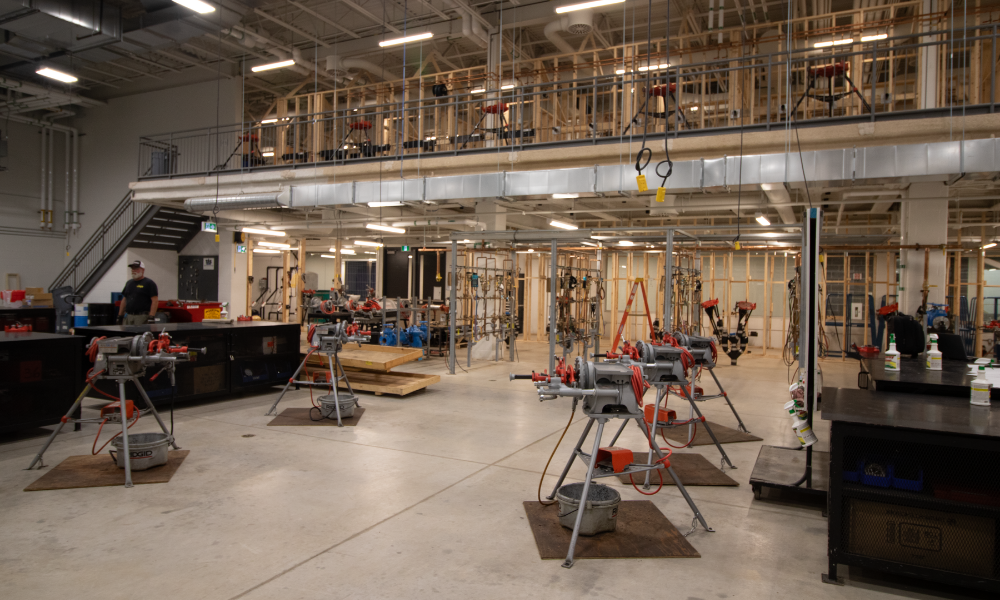
Conestoga College’s Skilled Trades Campus
Energy is a growing sector in Waterloo
Our established cleantech sector also encompasses battery and nuclear-related capabilities.