
Manufacturers that invest strategically in AI, talent and research ecosystems are better positioned for long-term success. Waterloo, one of Canada’s largest innovation engines, is helping manufacturing companies shift into the next gear.
The Greater KW Chamber of Commerce’s 2026 Manufacturing Summit brought manufacturing and supply chain leaders into the same room to discuss the future of the industry, innovation, talent pipelines and more. The consensus was that strategic investments in digital and physical AI, as well as in future-proofing talent, are paramount.
At the event, Gavin Fitzpatrick, Market Manager at Waterloo EDC, moderated a panel titled, “Manufacturing the Future: Innovation, AI & Competitive Advantage,” featuring Jill Anderson, Senior Business Advisory, Technology at BDC, Chris McLean, Senior Manager – Workforce Planning & Talent Development at Toyota Motor Manufacturing Canada and Greta Cutulenco, Founder & CEO at Acerta Analytics Solutions.
Here are the key insights from the Manufacturing Summit and the “Manufacturing the Future” panel.
The best time to invest in AI is now
Investing in leading-edge manufacturing technology can pay dividends. The most productive manufacturers invest 1.5x more on machinery and equipment, and 1.8x more on digital, compared to their peers. Continuous and strategic investment in equipment, machinery, automation and AI positions manufacturers for long-term success.
“If you’re standing still, you’re actually moving backward. That can become unrecoverable pretty quickly,” said Anderson.
Automation, robotics and machine learning have long existed on the factory floor, but the convergence with AI is driving a phenomenal amount of new data. These insights help manufacturers understand what exactly they need to boost quality and productivity.
At Acerta, Cutulenco is seeing forward-thinking manufacturers double down on AI applications in the last couple of years. Her practical advice? For manufacturing companies, it’s better to focus on and optimize one specific application for AI, rather than trying to do everything at once. Start small, stay focused on critical areas and build momentum from there.
“Crawl, walk, run, rather than rushing through it all,” said Cutulenco.
Some efficient entry points can be within the organization itself: integrating AI into day-to-day workflows like document management, information processing, maintenance manuals or product documentation. When it comes to the production environment, look at key areas and start to improve data quality and availability right across the shop floor.
“The important thing is to start,” said Cutulenco. “Start by gathering data, making it accessible and using it in day-to-day operations. The value will come faster than you expect.”
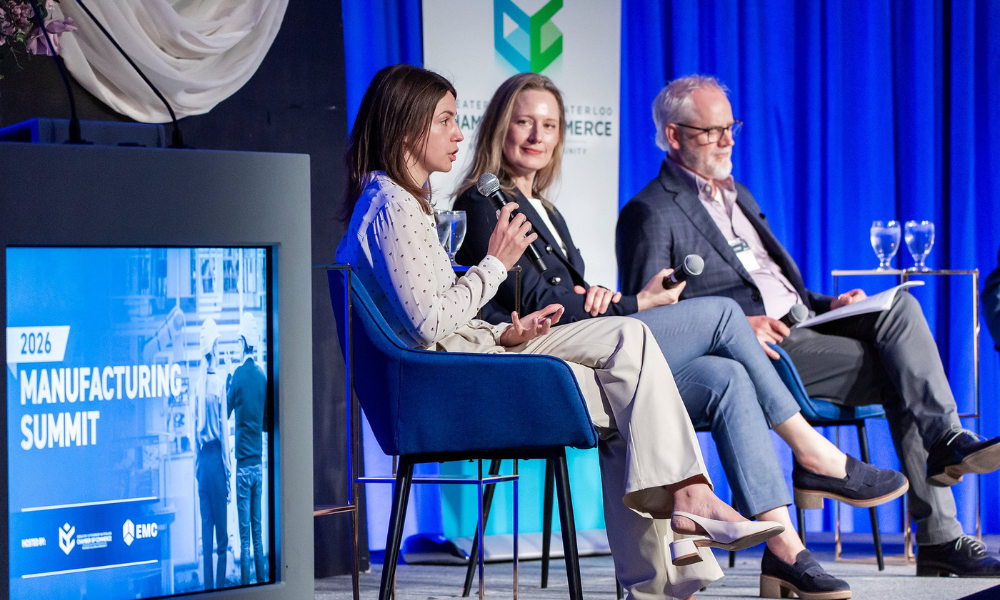
Greta Cutulenco speaking at the Manufacturing Summit (Adamski Tomasz Photography)
Tap into research ecosystems
Beyond investment, manufacturers need to align themselves with innovation hubs and research centres. Businesses that connect with these cutting-edge ecosystems can take research directly from the lab to the shop floor, creating a symbiotic relationship.
In the Waterloo region, the factory floor is wired directly to research labs. For example, there’s the SMART Centre at Conestoga College, which Toyota frequently taps into for R&D and talent, the Multi-Scale Additive Manufacturing (MSAM) Lab and the Waterloo Centre for Automotive Research (WatCAR) out of the University of Waterloo.
Research labs aren’t just about key insights – they’re also an incubator for business ideas. Cutulenco shared that Acerta actually started as a “research group of the University of Waterloo in 2017 before transitioning into commercial AI and machine learning applications in manufacturing.”
Beyond research hubs, ecosystem support organizations like BDC, the University of Waterloo, Conestoga College, the Accelerator Centre and Velocity Incubator can support your manufacturing innovation journey. They’re a structural driver of productivity and competitiveness, and manufacturers can leverage them to accelerate the research-and-innovation-to-production pipeline.
Prioritize talent
Talent is one of the most important factors in a manufacturing investment decision. You can have the land, building and energy infrastructure, but if you don’t have the right talent to support your operations, success is difficult to come by.
Waterloo’s manufacturing ecosystem relies on the strengths of our post-secondary schools and our institutions’ ability to adapt programming to the needs of local businesses. In fact, the University of Waterloo is producing some of the most sought-after engineering graduates in the world. In our community, industry regularly partners with academia, linking highly skilled, adaptable talent to local companies.
For example, Communitech’s newest program, AI@WORK, pairs University of Waterloo students with small-to-medium-sized businesses in the region to build, deploy and validate real-world AI solutions. Initiatives like AI@WORK can help manufacturers take the necessary first steps to investing in innovation, while working closely with future talent.
Our local co-op programs also ensure manufacturers build a strong talent pipeline. Toyota partners with colleges and training institutions, bringing in about 50 co-op students per year. “Our goal is ensuring team members are prepared not just for the jobs of today, but for the jobs of tomorrow,” said McLean.

Chris McLean adding insight to the panel discussion (Adamski Tomasz Photography)
Adjust to changing talent dynamics
Manufacturers will continue to need skilled and engaged team members to ensure operations thrive. However, the nature of those skills is changing, evolving from task-based work to more system-focused, problem-solving and technical work.
“Manufacturing careers are becoming more dynamic and knowledge-based, and workforce development needs to evolve alongside technology,” said McLean.
Anderson added, “We’re seeing people and robotics working side by side, each learning to anticipate the other. [This] protects the skills and knowledge of engaged workers while alleviating more mundane physical tasks. That’s true collaboration.”
In addition to robot-human collaboration, consistent knowledge exchanges between team members are instrumental to future success. Toyota ensures there’s a two-way learning dynamic taking place in the organization. Tenured team members share long-held knowledge with the younger workforce so they develop into future leaders, while younger team members teach older employees about digital fluency and AI tools.
“We’re seeing that two-way learning take place right across the organization,” shared McLean.

Jill Anderson discussing manufacturing talent (Adamski Tomasz Photography)
Adapt and evolve
The final question of the panel was directed at McLean: “When you think about the future of manufacturing in Ontario, what gives you confidence in the next generation of talent entering the industry?” asked Fitzpatrick.
McLean explained that our local manufacturing industry has continually proven it can evolve, and today’s youth continue to bring the skills needed—strong technical awareness, curiosity and adaptability—to invent the future of manufacturing.
“What gives me confidence [in the future of manufacturing in Waterloo] is our own history,” said McLean. “Success doesn’t come from technology. It comes from people who are willing to continually adapt, learn and grow.”
Those are the kind of people you’ll find in Waterloo.
Key Takeaways
- The most productive manufacturers invest significantly more in AI and digital tools than their peers
- Waterloo’s research ecosystem gives manufacturers a rare advantage: cutting-edge R&D available right next door, ready to move from lab to shop floor
- As manufacturing shifts from task-based to knowledge-based work, co-op programs and industry-academia partnerships are building essential talent pipelines
- Manufacturers cultivating teams that are curious, adaptable and committed to continuous learning are best-positioned for success in the industry
- Confidence in the future of the Waterloo region’s manufacturing ecosystem comes from its track record of adaptability and evolution