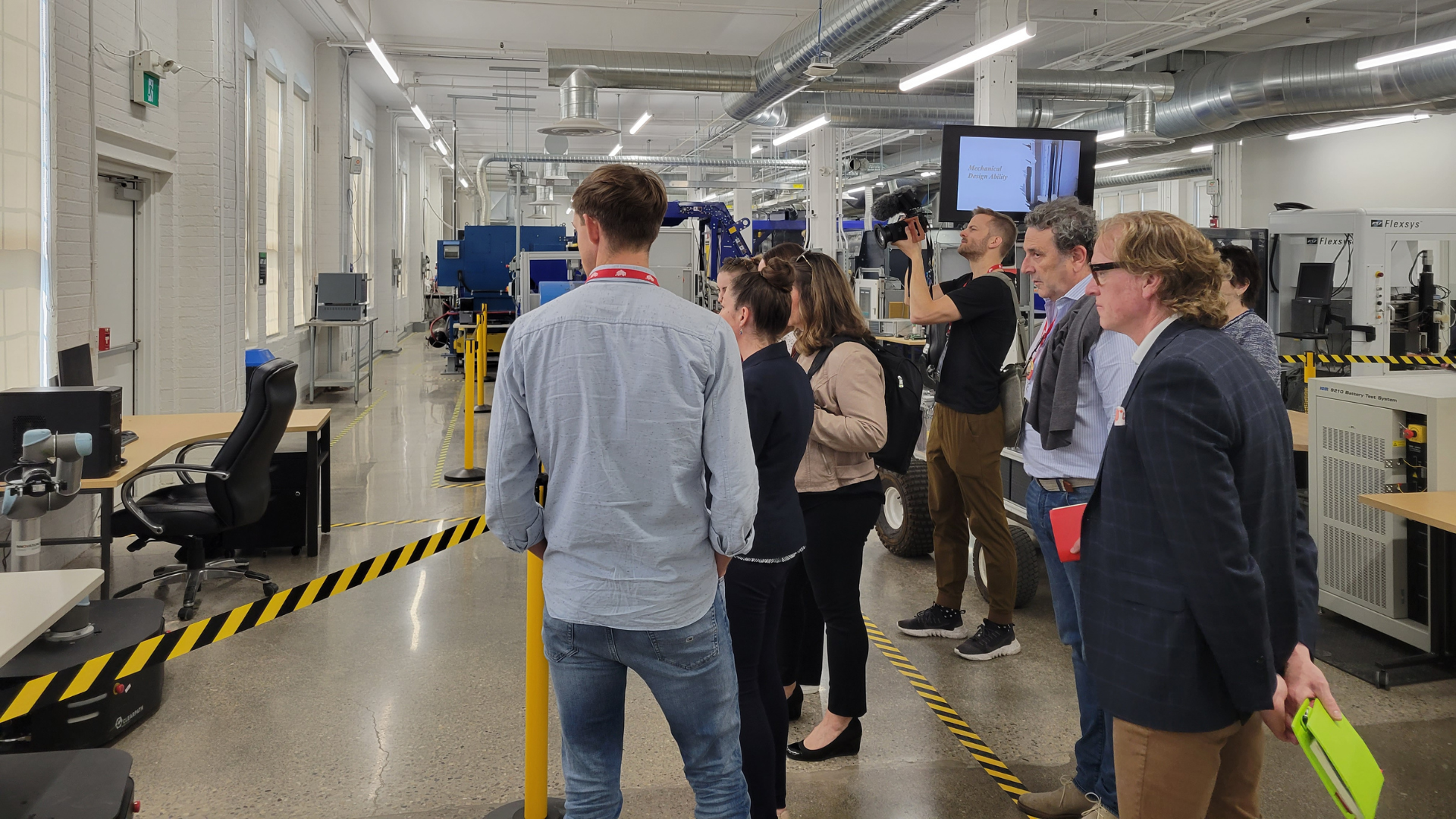
The SMART Centre at Conestoga College is an incredible resource for innovation-focused manufacturing companies. Not only can this R&D hub help coordinate complex research projects, but it can help find relevant funding and connect companies with top-notch new talent.
Research and development are the heart of innovation, but how does a company find the right research support? That’s a problem that the SMART Centre at Conestoga College seeks to solve. Stretching across everything from manufacturing automation to cutting-edge artificial intelligence, the Centre is a one-stop shop for finding the right research partners in the Waterloo area and beyond.
Waterloo is known around the world as a hub for research and innovation. Every year, startups launch out of our post-secondary institutions, working to turn research discoveries into commercial products and services. But it’s not just startups that benefit from this ecosystem. Industry leaders in advanced manufacturing, AI and cleantech choose to expand their operations in the Waterloo area for the same reason startups do – talent and expertise.
For companies seeking R&D support in hands-on fields – manufacturing, healthcare, food processing – there’s no better source of either talent or expertise than Conestoga College. Home to one of Canada’s largest trades schools and hands-on programs in process automation, robotics, power management and more, it’s the perfect place to recruit and empower a future workforce built to define the next wave of industry.
But more than simply a source of talent, Conestoga is also home to an array of research centres – led by experts with industry expertise – that are uniquely focused on supporting companies. As Jeff Dukes, the SMART Centre’s director, might say, it isn’t research for the sake of research, but research to build new solutions to drive real-world innovation.
Key Takeaways
- The SMART Centre is a key touch point for Conestoga’s Research Innovation & Entrepreneurship, with seven research centres. The right mix of students, researchers and faculty is assembled for the problem at hand.
- Since 2019, the SMART Centre has hired over 559 students who work directly with industry partners. Many go on to be hired directly by the companies they work with.
- Companies can pay fee-for-service for time and materials, or pursue funded research through key government agencies, where a 20–30% industry contribution unlocks the rest through grants, significantly lowering the cost of R&D.
- Waterloo’s real advantage is its density and interconnection. Companies get access to tightly connected talent, research and industry, rather than having to navigate siloed resources on their own.
The SMART Centre: One door to access dozens of research specialties
The SMART Centre is a single entry point for the industry to access the research tools, skills and talent at Conestoga College. The centre focuses on manufacturing, information technology, automotive, health tech, food and beverage manufacturing and zero-emissions industries. Dukes and his team work with industry partners to define what their problem might be and then bring in the right mix of students, researchers and full-time faculty to work on a project.
“What we’re trying to do is ensure we’re solving the problem our industry partner has in their R&D or innovation challenge,” Dukes says.
Conestoga’s SMART Centre is one of 16 nationally recognized Technology Access Centres (TACs) in Ontario – a network of college-based organizations that bridge the gap between industry needs and technological advancements. While each TAC offers applied research in specific areas, Dukes says Conestoga is unique in its scope of research areas.
“Conestoga is one of the largest colleges in Ontario, so we have so many talented students and programs to pull from,” he says. “Many applied research centres focus on one discipline. Our advantage is that we can bring together expertise from many disciplines. A project involving artificial intelligence may also require sensor development, advanced manufacturing, software development or cybersecurity. We can assemble the right people around the challenge.”
That collaborative philosophy extends across Conestoga’s Research, Innovation & Entrepreneurship ecosystem. Together, the SMART Centre, Conestoga Food Research & Innovation Lab, Centre for Health Care Research & Innovation, Conestoga Biotechnology Research & Innovation Hub, Conestoga Social Innovation Lab, Centre for Commercialization and the Conestoga Entrepreneurship Collective form a multidisciplinary network that brings together researchers, faculty, students and industry partners to solve complex challenges.
“A company might come in looking for packaging help or a shelf-life study, but also want to improve automation or packaging in their facility. We can bring in the food research team and work in tandem,” Dukes says. “If we don’t have what they need, we can refer them to another college that does. We’re here to make sure everyone we engage with gets the help they need.”
Rather than operating independently, these centres collaborate across disciplines, drawing on diverse expertise to address real-world problems that rarely fit within a single field of study. Whether advancing manufacturing technologies, developing sustainable food solutions, improving health-care outcomes, supporting commercialization or fostering entrepreneurship, Conestoga assembles the right combination of knowledge, talent and applied research capabilities to help partners move ideas from concept to impact.
" Our advantage is that we can bring together expertise from many disciplines. A project involving artificial intelligence may also require sensor development, advanced manufacturing, software development or cybersecurity. We can assemble the right people around the challenge. "
Jeff Dukes
Director, SMART Centre
Multiple funding models
Project funding typically follows one of two models.
The first is a fee-for-service model where industry partners pay for time and materials on a project. The second model is funded research where the SMART Centre can apply for funding from a federal or provincial organization such as Natural Sciences and Engineering Research Council of Canada (NSERC), Federal Economic Development Agency for Southern Ontario (FedDev) or the Ontario Centre of Innovation (OCI).
“Those projects typically involve a 20–30% cash contribution from the industry partner, with the rest coming through grant funds. That’s where a lot of partners like to work, because it reduces the cost of R&D for them significantly,” he says.
From co-op to career-ready
Whichever funding model an industry partner chooses, Dukes notes that students from the college play a critical role in every project.
“Hiring students every semester is the core of what we do. They get the learning and experience of working with our senior researchers to deliver a project,” he says.
Since 2019, the SMART Centre has hired over 559 students to work on projects. Dukes says the centre is the largest employer of co-ops at the college. Many of those students go on to work for industry partners after graduating.
After they are hired, students work directly with industry partners on their projects. It’s real-world work experience, with students presenting their ideas, receiving feedback and building and testing prototypes.
“They’re not sitting in the back corner doing drawings. They’re the ones doing the real work and getting the core experience. That means industry partners can see how a student works and thinks, and the student gets deep insight into the company and its products,” Dukes says. “It’s a huge benefit for partners because they get an extended interview process with those students. The students are hired by us, so the partner doesn’t have to deal with the overhead and administrative side of hiring—they just get to work with them and see their skills and capabilities firsthand.”
Since the SMART Centre is helping with new products or tools, students are often working at the bleeding edge of technology. If the industry partner chooses to hire them after graduation, the students are able to continue their work right away instead of starting from scratch.
Example: Vortex Technology Group energy storage system
One example of the SMART Centre’s impact is a partnership with Vortex Technology Group (VTG). The Toronto-based company develops battery storage technology for telecom, microgrids and EV charging stations.
VTG partnered with the SMART Centre to design and develop a containerized energy storage system. It uses solid-state supercapacitor batteries installed inside converted shipping containers for use as backup power in remote areas where diesel generators are not an option.
“The students, with guidance from our team, have fully developed an intelligent battery management system and the web interface and control system to monitor it. It’s been a full development cycle over two years,” Dukes says.
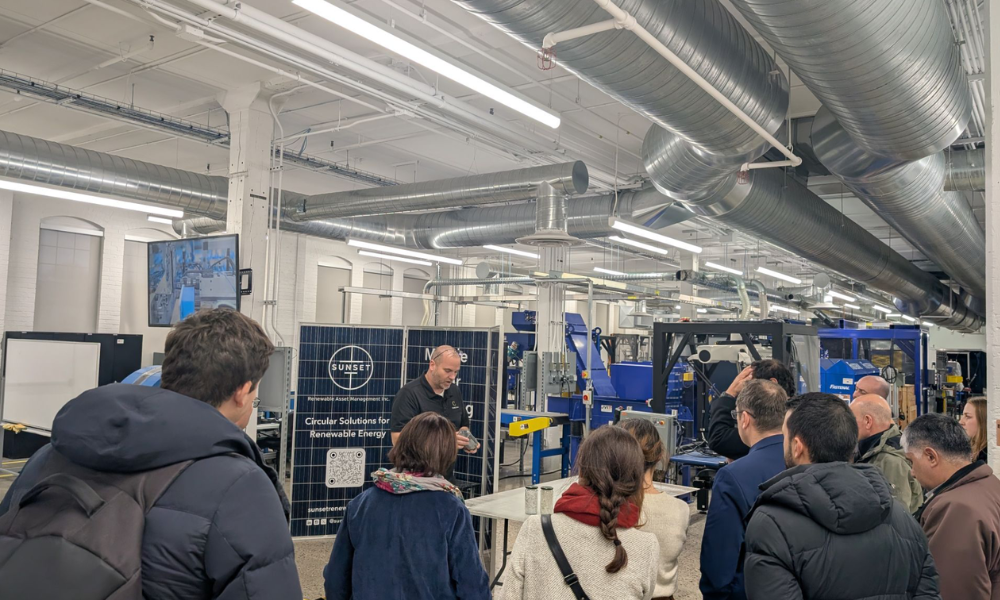
Companies touring the SMART Centre with Jeff Dukes
Waterloo helps companies build what’s next
As the development of artificial intelligence technologies evolves, Dukes says he is hearing more requests from advanced manufacturing for help adopting AI. He is quick to point out that successfully implementing an AI solution comes down to one thing—data.
“Companies need a data set to build a model that will actually help them, so we make sure we can help them gather that before they try to dive in,” Dukes says.
That same problem-first approach applies to companies at any stage—whether they’re already in Waterloo or looking to expand here. Dukes says the SMART Centre’s role is often to pick up the work companies don’t have time for.
“Even companies that do have an R&D organization often have a long list of projects, with only the top few priorities getting real attention,” he says. “We help companies get traction on those overlooked projects by assembling a team to drive their innovation forward.”
Ask Dukes why industry partners choose the Waterloo region and he’ll tell you one thing—it’s the ecosystem.
“The talent, the research, the startups, the tightly interconnected industry we have here is a huge benefit for anyone coming to work in this region,” he says. “Being in Waterloo puts you at the centre of everything you could need in terms of talent and resources to succeed.”
Discover the industry support organizations that can help your company with R&D, talent attraction, innovation, commercialization and more.