The short version
Waterloo-based PPO is revolutionizing the way we ensure food safety. To do it, they’re building on a tradition of innovation, deploying artificial intelligence and tapping into the resource that makes Waterloo the best place for companies developing manufacturing technology or cutting-edge new production lines: our people.
Chicken fingers, burger patties, ready-to-heat breakfast sandwiches? The frozen aisle of your local grocery store offers a seemingly endless selection of items to add to your shopping cart. But while most people might pause to think about price or nutritional information, Heather Galt is thinking about how the product got safely from the farm to the freezer.
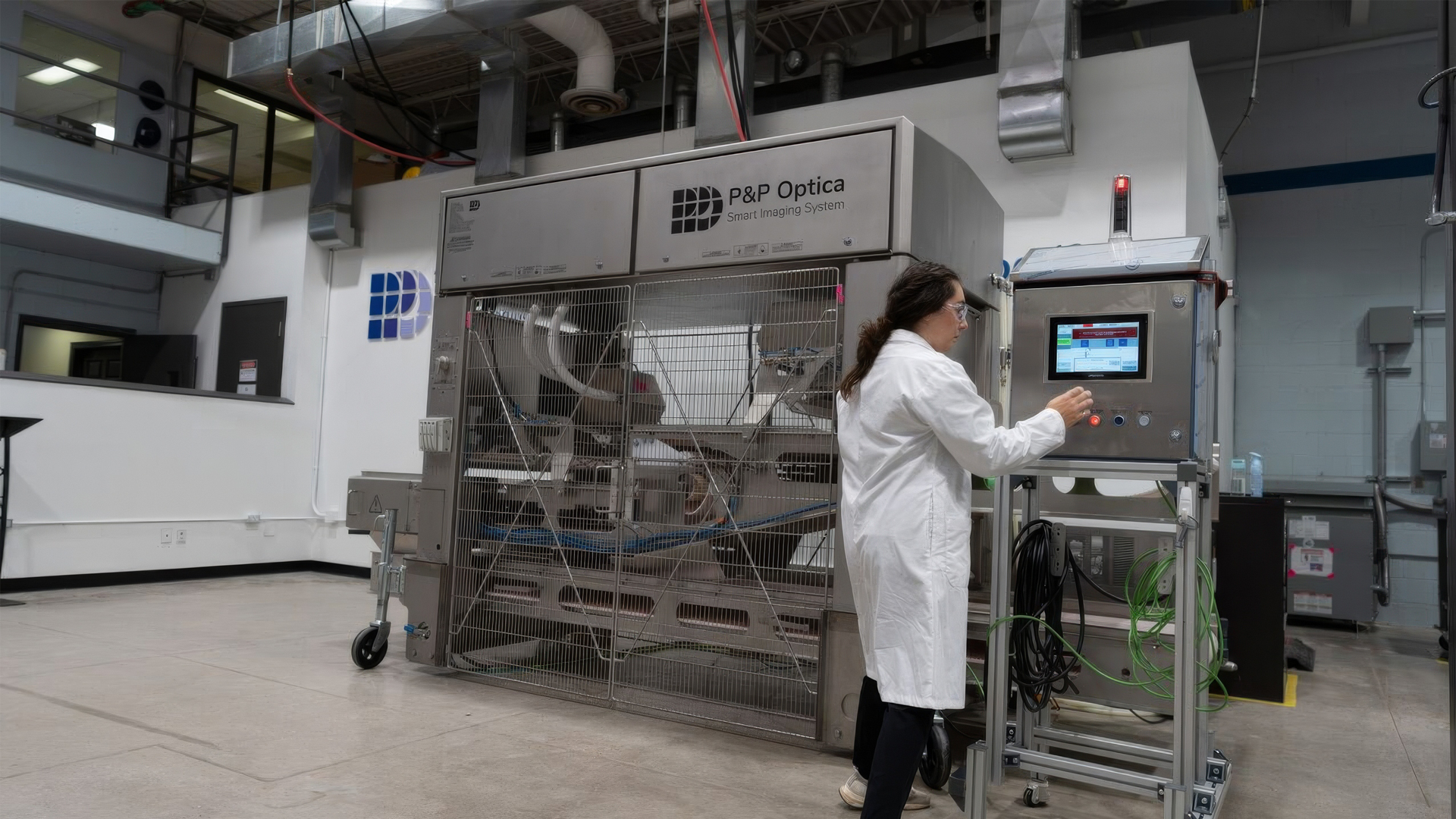
Galt is the Chief Customer Officer at PPO, a Waterloo-based technology company that designs and manufactures foreign material detection systems that are used in meat processing facilities. Meat processors install the company’s Smart Imaging System directly into production lines to detect personal protective equipment (PPE), bone, wood or other foreign objects before they make their way to a shopping cart or your local restaurant.
“We’re able to find things that none of us want to bite into, whether that’s in your chicken nuggets at a quick-service restaurant or the bacon from your grocery store,” Galt says. “Meat processors are really focused on quality and they want to make sure that the products they are delivering to their customers are satisfying and safe. PPO plays a big role in helping them to do that.”
Key Takeaways
- PPO’s Smart Imaging System combines high-speed hyperspectral cameras and AI to evaluate product quality and detect foreign materials — plastic, wood and more — on meat processing lines in real time, rejecting contaminated product in a fraction of a second.
- Founded as a research company, PPO has seen its technology used in healthcare, energy and even aboard the International Space Station before going all-in on food inspection in 2016.
- The company has grown entirely in the Waterloo area, drawing on local co-op students, veterans of other tech companies, and an all-local leadership team — with over 2 dozen systems now running in Canada, the US, Europe and Australia.
- The secret sauce for PPO is the region’s ecosystem of companies solving “unglamorous problems” and deep B2B expertise that is fundamental to how business gets done.
Seeing what the human eye misses
PPO’s Smart Imaging System uses a combination of high-speed hyperspectral cameras and artificial intelligence to detect foreign objects and evaluate quality in real time on a processing line. The ‘real time’ part is where the magic happens. Meat processing lines move fast — and they’re not slowing down.
Recent proposed changes to chicken processing by the USDA Food Safety and Inspection Service (FSIS) in the U.S. could see over 10,000 pieces of meat moving through a facility every hour. That breaks down to only 0.34 seconds of inspection time per item. With more products moving through these facilities, detecting foreign materials becomes even more challenging.
That’s where PPO comes in.
Every material absorbs, reflects and emits light differently. Unlike human eyes that see three colours, PPO’s high-speed hyperspectral camera can “see” 500 bands simultaneously. Its AI-powered software takes the camera data and uses it to identify the chemical composition of the material. If it’s not supposed to be there, the system rejects contaminated product before it travels more than a few feet down the line.
“Low contrast things like a piece of wood on a piece of fat just light up like a Christmas tree for us. A human would never notice it,” she says.
AI is the key to PPO and the future of manufacturing
The hyperspectral cameras are impressive, but Galt says it’s the data that makes everything possible. With systems operating in plants for the last 6 years, the company has collected over 10 petabytes of data. It’s the equivalent of Netflix’s media library. Times three.
“Even though it looks like our most important feature is the sensors that we put into plants, the most important thing we build is the software that makes those sensors work. All this data that’s being collected is used to train our software to make almost instantaneous decisions about what’s a good product and what’s not good product,” Galt says.
This data and software is the real-world application of artificial intelligence to the manufacturing industry. Galt argues that artificial intelligence isn’t a separate trend but a key ingredient in unlocking more impactful automation applications.
“Automation doesn’t work without AI,” she says. “As AI gets better and automation becomes more important — as people want to do less repetitive work — AI and automation are going to hold hands and take us into the next stage of economic growth. They have to work together.”
Built on a foundation of cutting-edge research
PPO has been focused on food inspection for the last decade, but the company’s origins go back to 1995. Like many tech companies in Waterloo, PPO had its start as a research project.
Founder Dr. Romuald Pawluczyk launched the company with a singular goal: design and build the most advanced spectrometers possible. In 2005, his daughter Olga took over as CEO and led the company as it explored industries that technology could make the biggest impact. PPO’s spectrometers have found homes in healthcare, energy and even 400 kilometres above Waterloo, aboard the International Space Station.
In 2016, the company spotted a gap it was uniquely positioned to fill, Galt says. Food processors needed better ways to catch what didn’t belong in their products, and no one had brought this level of imaging technology to the industry. PPO went all-in on meat.
Today, PPO’s systems inspect billions of pounds of product across North America, Europe and Australia. And the company has done it all from the Waterloo area.
From Waterloo to the world
It’s fitting that a company bridging farming and technology grew up in the Waterloo area, where world-class optics research and some of Canada’s most innovative meat processors can be found down the street from each other.
Galt says building in Waterloo’s interconnected ecosystem just makes sense.
“The ecosystem in Waterloo has a really diverse set of companies. They mainly focus on what I would call the unglamorous problems that maybe don’t necessarily show up every day in the grocery store or at the mall, but they’re fundamental to the way business gets done. And that expertise allows us to build what we do here,” she says.
Having access to experienced and developing talent has also been crucial to PPO’s growth. The company’s leadership team is based in the area, with many crossing paths in university or working at companies like BlackBerry, D2L, Manulife and others.
“I think the talent in the Waterloo area goes beyond just about any other region I’ve ever seen, and I’ve been all over the world,” she says, adding that Waterloo is especially adept at producing new talent. “We have a number of co-op students who work here every semester from the local universities in Waterloo Region and beyond.”
It’s not just students and staff that PPO has drawn from the Waterloo ecosystem. Galt says the business community’s willingness to share what it knows — across sectors and company sizes — has shaped how the company grew.
“Waterloo is really great at sharing what it knows with one another. If you need help with something you’re doing as a startup or a scaling company or an enterprise, there’s probably somebody here you can tap into to get that knowledge and expertise,” she says. “I can’t imagine us running our business anywhere else.”
What keeps PPO in Waterloo?
Apply AI in Waterloo
There’s no better place to be if you’re looking to innovate in AI or incorporate AI into your operations.