
The short version
Time zones are an underappreciated element for companies considering expansion. Choosing the right time zone means building a bridge to new markets while maintaining a connection with headquarters. Expanding to the wrong time zone can create logistical issues.
Geography is a strategic asset. Sure, it matters on a local level—you need to be close to your markets, suppliers, talent pools and partners. Zoom out a little, though, and it’s clear that global geography is significant, too. Time zones influence business success.
Say your company is headquartered in Europe. Germany, for instance. You want to work with suppliers and partners in North America, but you keep running into issues: long deal cycles, missed communication, poor logistical planning. There’s a lack of international collaboration, and eventually, a potential loss of revenue in a key continental market.
The solution has everything to do with time zones.
Waterloo’s Eastern time zone helps European companies access North America, since our region shares 100% of business hours with hubs like New York and Boston, and 5+ hours with cities along the West Coast, like San Francisco and Seattle.
What’s more, Waterloo’s strategic location in the Eastern time zone also provides one of the best collaboration windows between North American and select European teams. For example, your German company can meet with your Waterloo team in the afternoon for live conversations.
Here’s how it works, and why it matters:
Access North America
The advent of the modern railway ushered in time zones in North America in 1883. US and Canadian railways adopted a unified time zone system to ensure passengers didn’t miss their trains and to minimize railroad accidents.
The sheer size of our continent demanded four major time zones, shared between the US and Canada: Eastern, Central, Mountain and Pacific. Canada also has Atlantic and Newfoundland time. The Waterloo region is in the Eastern time zone, along with most cities along the Eastern seaboard (New York, Boston, Philadelphia and Washington, D.C.), as well as more landlocked hubs like Detroit and Atlanta. Toronto, Ottawa and Montreal land in the Eastern time zone, too.
Expanding to the Eastern time zone allows European companies to collaborate in real time with North American customers and partners during regular business hours. It opens up a world (or more accurately, a continent) of possibility for global growth.
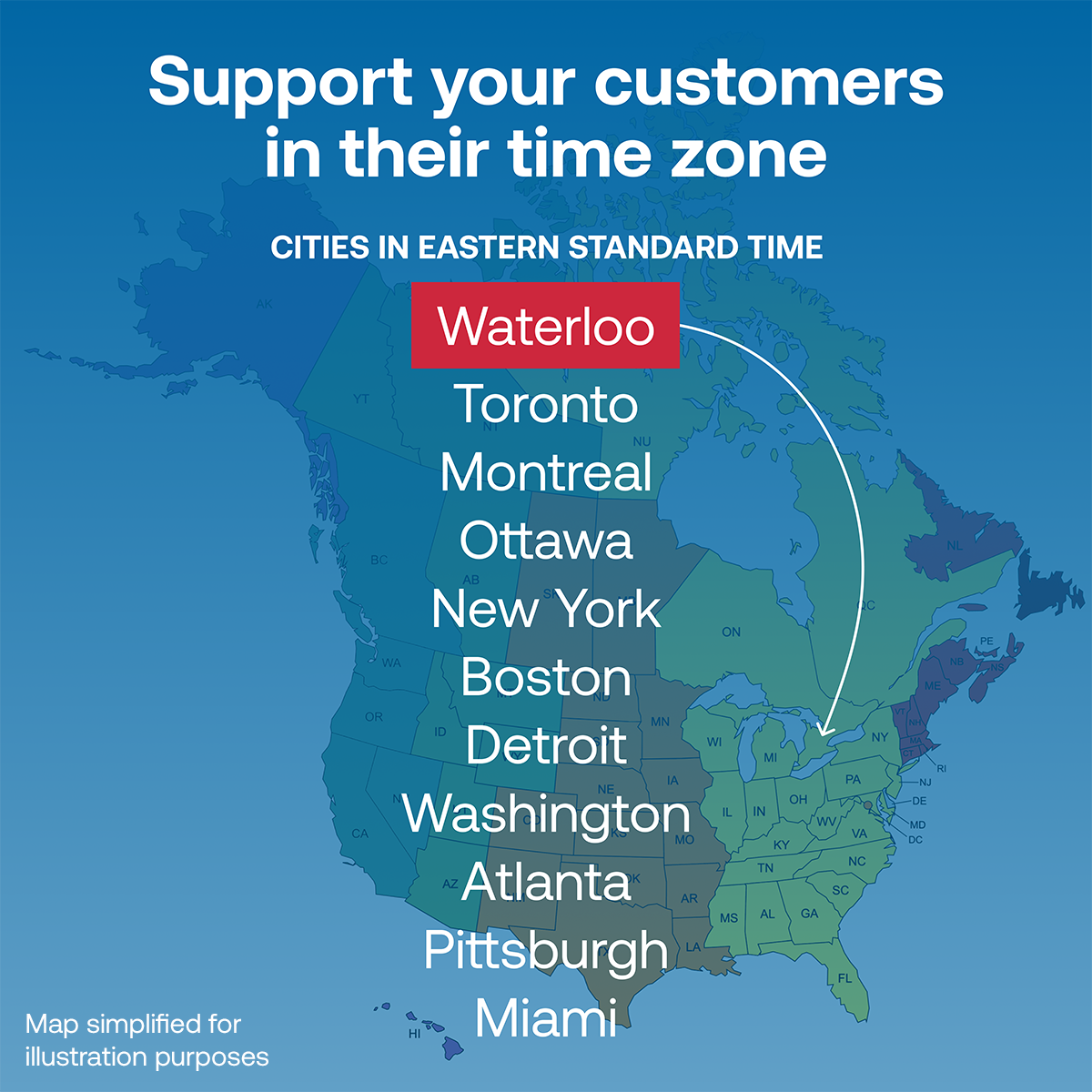
In the Eastern zone, you also share more than 5 hours of live collaboration with cities in Central and Pacific time. Austin, Chicago and Mexico City are in the Central time zone (which is only one hour behind Eastern, showcased in orange on the map), and Seattle, Los Angeles and San Francisco are in the Pacific zone (three hours behind, highlighted in turquoise).
Communicate and collaborate with Europe
Expanding here doesn’t put your team out of touch with your European headquarters, though. Your business days can still overlap for a few hours each afternoon. It’d be much harder to expand to North America’s Pacific coast, where you’d share zero overlapping hours with any European city.
Time zone alignment between the Eastern time zone and several European cities can facilitate same-day decisions and approvals, streamline deal cycles and build stronger relationships among headquarters, offices and stakeholders.
Plus, there’s the human side of time zone alignment – your employees enjoy better work-life balance because they aren’t required to work outside of their regular business hours just to communicate with team members, stakeholders or customers in a different time zone.
Time zone alignment is important for any company that wants to secure global success. If you’re a European company expanding to our continent, the Eastern time zone provides the greatest advantage. For reasons such as location, talent, cost and more, Waterloo is the perfect place to locate your new North American office.
Choose Waterloo for an Eastern time zone expansion
Waterloo’s location can be a major draw for European companies considering time zone alignment as a strategic advantage. But it’s not the only thing on offer here.
We’re part of the largest tech cluster in North America, with 399,900+ tech workers (the Toronto-Waterloo Corridor), and our community is the 2nd fastest-growing tech talent market at 37.4%. The University of Waterloo is one of the top tech and AI schools in North America, graduating more computer science students every year than MIT, Stanford and UC Berkeley.
We’re not just a tech hub, though. Manufacturing is—and has been for 150 years—the backbone of the Waterloo region. There are nearly 50,000 manufacturing workers in Waterloo, making up 14% of our total workforce. Conestoga College’s Skilled Trades Campus is the largest and most comprehensive in Canada, enabling a secure manufacturing talent pipeline for incoming companies. We’ve combined tech and manufacturing traditions to become the largest robotics and automation cluster in Canada.
Plus, in addition to time zone alignment, your company can find cultural alignment here, too. European immigration has always been a part of the Waterloo region’s story. We share a deep historical connection, mutual respect for institutions and a common set of political and cultural values.
In fact, one of our cities used to be called Berlin, and we host the world’s largest Oktoberfest outside of Germany every fall. Our country’s official second language is French, and our system of law and politics is the same as that of the United Kingdom.
You may recognize a lot of yourself in this country. For a visiting European, we’d wager that Canada will look and feel a lot more like home than anywhere in the US.
Key Takeaways
- Waterloo’s Eastern time zone gives European companies 100% business-hour overlap with North American hubs like New York, Boston and Atlanta, and more than 5 hours with West Coast cities like San Francisco
- The Waterloo region still shares working-hours overlap with European headquarters each afternoon, unlike West Coast locations, which share none
- Time zone alignment shortens deal cycles, supports same-day decisions and helps employees maintain a healthy work-life balance
Discover how global companies can access North America through strategic expansion