
The short version
Catalyst Commons, a coworking space in the heart of the Waterloo tech ecosystem, presents turnkey options for startups, scale-ups and major enterprise companies. Their commitment to flexibility and culture, as well as their sheer scale, makes them stand out from other coworking options. Commons, as it is known, is a great place to land for larger companies interested in getting an initial foothold in Canada’s most dynamic tech community.
Catalyst Commons has everything you’d expect in a modern coworking space. Comfortable desks, flexible offices, infinite coffee, lots of free parking and dependable WiFi. It’s big, too. At over 125,000 square-feet, Catalyst Commons – located in Kitchener, a part of the Waterloo region – is the largest coworking facility in Canada.
But it’s not its size or amenities that define it, says co-founder and managing partner Amber French. As she tells it, what sets Commons (as the regulars call it) apart is the community that’s grown as organizations of all sizes and types have made their homes there.
“What’s been amazing is the mix. We have technology companies, non-tech supporting businesses, not-for-profits. It’s a bit of everything. It’s a really cool mix of builders in Waterloo region, tech or not, and that creates a richer environment and community,” French says.
It’s also housed within Catalyst137 – a massive building with a full restaurant, coffee shop and large corporate offices for D2L, Geotab, Carta, Siemens and more.
Catalyst Commons is more than just another coworking spot
Coworking means different things to different people depending on where they live. Angela Watkins, the general manager of Catalyst Commons, says she prefers to talk about it as being a flexible office space.
“That lends itself to companies looking for a great place to land: a curated, intentional culture with all of their workplace needs taken care of,” Watkins says.
For Watkins, that flexibility demonstrates itself in two unique ways. First, for companies looking to expand, relocate or bring their people back together, long lease commitments at traditional class A office space can stop discussions before they even begin.
“We often get enterprise companies saying they just can’t handle the liability of a 10-year lease, so they need something very flexible. We commonly offer 12-, 24- and 36-month terms, and we also offer month-to-month,” Watkins says.
The second way Commons offers flexibility is in growth capacity.
“We have a couple of examples of members who came in as a hot desk and grew all the way up to a 20-person office, with the space growing as they needed it and as the company was able to take on more,” says Watkins. “Our suites are typically 20 people and up and allow a more customized solution.”
A strategic location for keeping talent happy
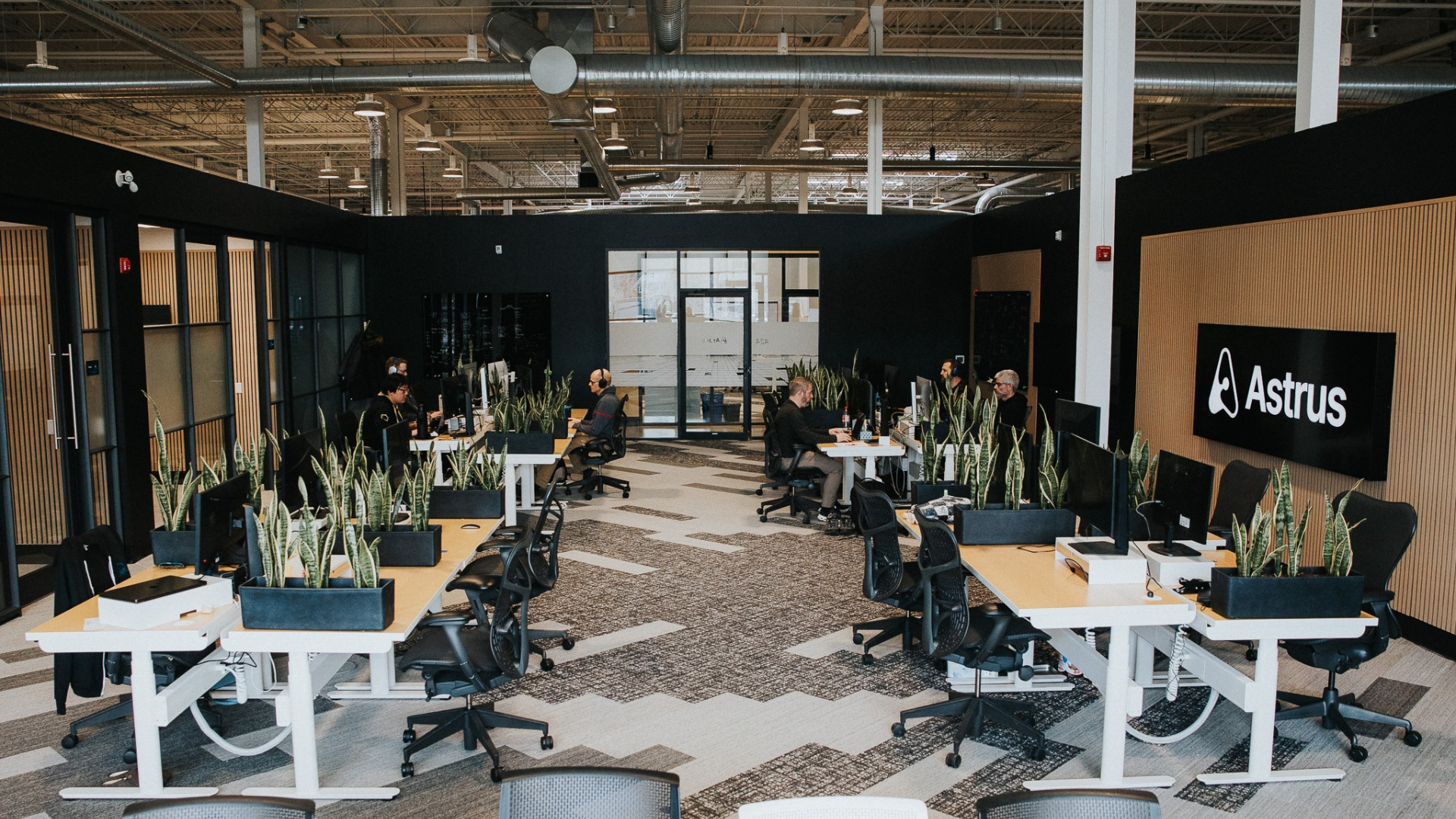
AI-chip design startup Astrus is one member that Watkins points to as a perfect example of Commons’ flexibility and adaptability in action.
“They came in and said, ‘We really need these blackboards, we need this connectivity, we need this to represent who we are, how we work and what our culture is.’ In the suites we have more room to make that happen,” Watkins says.
After recently raising a $12-million CAD series A round, Head of Talent and investor Steph Hector says the company’s space in Commons has become part of how it attracts the talent it needs to scale.
“We looked at it as part of our recruitment strategy. Catalyst removes the frustrations of going to an office. There’s parking, it’s on the Iron Horse trail, it’s near an ION station*,” Hector says. “It’s the tech space to be in.”
*Waterloo’s light rail transit system
A community that’s unexpected and intentional at the same time
Transportation technology leader Miovision has a special place in Commons. It’s a member whose CEO, Kurtis McBride, happens to be the co-founder of the coworking space. It’s the largest member of Commons, with dedicated workspaces, meeting rooms and phone booths for 120 employees.
But even with its large space, French says the company’s employees are as much a part of the community as the startup with two employees across the hall.
“They still connect into the greater Catalyst community. They attend all the events and use the additional workspaces and event spaces for team offsites,” French says. “120 workstations is not a typical coworking size, so there’s a whole continuum, from single-desk startups up to some of Canada’s top scale-ups, all operating in one space.”
The Catalyst Commons team runs over 200 events a year, from pop-up smoothie mornings to learn-from-the-experts workshops to holiday events for member families. In the summer, you’ll find employees from across almost every member company dressed up and tackling physical and mental games in The Commons Ultimate Challenge.
“Some employees and companies participate in everything, some in nothing, but it really helps solve the culture and community piece on the company’s behalf. I think that’s why our model is so successful,” Watkins says.
The right landing spot for international expansion
Going back to their initial idea for Catalyst Commons, Watkins says enterprise companies weren’t on their radar.
“I really thought this would be a tech startup space where they would grow from a small office to a large office and then go off and do their own thing. Instead, enterprise companies now come to us frequently looking for the environment we’ve built and all the solutions we have,” Watkins says.
One example is healthtech leader PointClickCare, which initially needed hot desks for a few team members in Waterloo.
“Their request was very different from what we had designed, so we created a product around it. That was so successful for them that they moved into a larger suite, curated to exactly what they wanted as a company,” Watkins says.
French says another example was a company of 20 people that only needed ten desks. The challenge was making sure their employees knew there was a space available before they commuted in. The Catalyst Commons team developed an internal booking system so employees know there’s a desk ready and waiting for them. There’s even a backup plan if someone shows up unexpectedly.
“We have our hot desks for overflow. One of the benefits of our space being so large is that we can be incredibly flexible in how we approach problems and work with companies to meet them where they’re at,” French says.
Commons is now a central part of the Waterloo tech ecosystem.
“We’ve naturally become part of the greater ecosystem, and it’s meant to be a continuum. We get a lot of companies coming to us after they leave Velocity, graduate from the Accelerator Centre or outgrow the smaller subsidized desks some of our partners offer. We’re a natural next step,” French says.
Looking back at the changes and evolutions since opening in 2020, Watkins says Commons has truly become a core part of building a tech company in Waterloo.
“We were thinking big,” Watkins says. “But it’s become much bigger than we could have imagined when we set out.”
The Summary
- Catalyst Commons is Canada’s largest coworking space with 125,000 square-feet of mixed-use space. It’s located inside Catalyst137, a 465,000 square-foot building that’s home to a restaurant, coffee shop and large tech companies like D2L and Geotab.
- Catalyst137 is centrally located steps away from the ION light rail transit system, the Iron Horse Trail and a quick walk to Kitchener’s historic Belmont Village shopping and dining district.
- Members include Miovision, PointClickCare, 45 Drives and the Kitchener Waterloo Symphony.
- Catalyst Commons is part of the Waterloo tech ecosystem, supports partners as an event space and is a place companies can land after they outgrow other programs.
Discover Canada's most dynamic tech ecosystem