
The short version
BWX Technologies (BWXT), a world leader in nuclear manufacturing, has made the Waterloo region its Canadian home. Built on an 180-year local legacy, the company is now at the leading edge of nuclear energy production, building large reactor components and small modular reactors in Cambridge, while its US operations include microreactor development that will change the industry. According to John MacQuarrie, BWXT’s President of Commercial Operations, this shift is just beginning, and Waterloo’s unique talent profile will ensure it stays at the centre of the new nuclear revolution.
What comes to mind when you think of nuclear power? For many people, it’s often the image of those hourglass-shaped (technically a hyperboloid) cooling towers, like the ones shown in the opening credits of The Simpsons.
In reality, those cooling towers are appearing less often as small modular reactors (SMRs) become more common in new nuclear projects. SMRs use compact designs that need far less space for managing heat, which reduces the need for large structures like cooling towers. They also have enhanced safety features, which include simplified systems and built‑in passive safety measures that help keep reactors stable even during unexpected events. This shift to SMRs is supported by BWX Technologies (BWXT), a leader in nuclear innovation with its Canadian headquarters in Cambridge.
The company recently celebrated the expansion of its Cambridge manufacturing facility. Together with its 150,000-square-foot training and field services facility in Kitchener, another community within the Waterloo region, BWXT has over 430,000 square feet to design, develop, service and manufacture the next generation of nuclear reactors for customers around the world—and maybe beyond.
BWXT is building on an 180-year legacy in the Waterloo area
BWXT’s roots in our community go back over 180 years to its start as Dumfries Foundry. The original business produced steam engines and doors for safes, says John MacQuarrie, President of Commercial Operations at BWXT.
“That’s why you see so many references to ‘Dumfries’ around [Waterloo Region],” he adds. “That business was sold to Goldie and McCulloch, before being bought by Babcock & Wilcox, the company that invented the modern industrial boiler.”
But the BWXT name has a more recent history. In 2015, the company split its nuclear and non-nuclear businesses, with the newly created BWXT taking on the nuclear business (and Babcock & Wilcox retaining the non-nuclear portfolio). The company is based in Lynchburg, Virginia, with over 11,000 employees around the world, including almost 4,000 in Canada.
Global demand is aligning with BWXT’s core business
“In the last two or three years we’ve seen dramatic policy shifts recognizing that the world needs more electricity, and needs it clean and reliable, independent of weather or time of day. Nuclear offers all of that,” MacQuarrie says. The result is significant new demand for nuclear power generation.
This rapidly growing global demand for power is due to many factors. In Canada, it’s everything from home and vehicle electrification to more advanced manufacturing facilities driving nuclear investments.
But it’s a broader trend, too.
MacQuarrie notes that the United Kingdom, France, Poland and South Korea are constructing new power plants and planning for future growth. Sanctions on Russian natural gas are also changing how European countries approach their power generation plans. In Asia, he points to China as an example of rapid nuclear adoption and expansion.
“China’s deployment is incredible. It’s the fastest in the world by far, across small, large and advanced reactors. And countries not yet nuclear, like Indonesia and other Asian nations, are exploring it,” he says. “In three decades in the industry, I’ve never seen anything like this.”
With more than 440 reactors across 30 countries – and more needed – the time is right for BWXT.
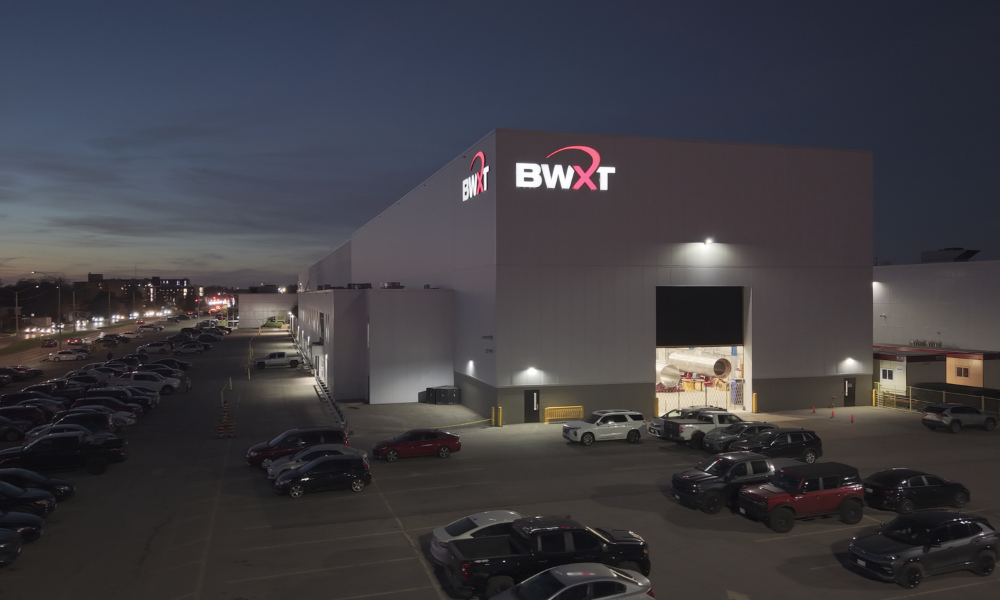
BWXT’s plant in Cambridge.
BWXT is growing – fast – to meet the need for nuclear
“We’ve seen a lot of growth in demand for what we do, and we’ve grown to meet it, either by adding capacity or by acquiring businesses,” MacQuarrie says. “Since we opened in Cambridge in 2015, we’ve gone from three hundred to nearly 4,000 employees in Canada. That’s a dramatic, order-of-magnitude growth.”
BWXT Canada exports reactor parts and equipment to Europe, Asia, South America and the United States. They focus on commercial customers, while the US operation serves government customers.
He says the facility in the Waterloo region is unique in North America.
“There’s no other plant like it. We’ve added another 55,000 square feet. We’ve bought a lot of very unique, high-tech manufacturing equipment and we’re adding people every week. We’re hiring and training at the maximum rate we can,” he adds.
In Ontario, current projects include reactor life extension projects at Bruce Power and Ontario Power Generation’s Pickering plant and the construction of new reactors at the Darlington Nuclear Station in Bowmanville.
“They’ve announced plans for four reactors there. Beyond that, we’re hopeful for what’s described as Bruce C, maybe up to four more reactors, and Wesleyville in Port Hope. We see a bright future beyond what we’re doing right now,” MacQuarrie says.
From the shores of Lake Huron to the Sea of Tranquility
Innovation in nuclear technology is never at a standstill.
“There’s breathtaking innovation. I’ve never seen so much capital, billions of dollars, flowing into advanced reactors and new forms of reactors. Right now, we cool reactors with water, but many advanced reactors use liquid metals or gases, and BWXT is developing that,” MacQuarrie says.
The sky’s not the limit for the company, either. In the United States, BWXT is researching reactor designs that may one day power permanent settlements on the Moon and beyond. The company’s expertise in microreactors gives it an edge in designing the type of reactors needed for the Moon’s harsh environment.
“A lot of people don’t realize a lunar night is 14 days long. That means no sun for 14 days, in an extremely cold, harsh environment. I’m not an astrophysicist, but you can’t put a water-cooled reactor there,” he says.
To solve this problem, BWXT has developed uranium-based reactors optimized in size and weight for the space environment, the power they provide will enable various systems to survive frigid temperatures and operate continuously on the moon.
MacQuarrie is quick to note that the company is also leading the way in the development of new nuclear medicine discoveries, too, and produces radioactive isotopes used in cutting-edge cancer treatments.
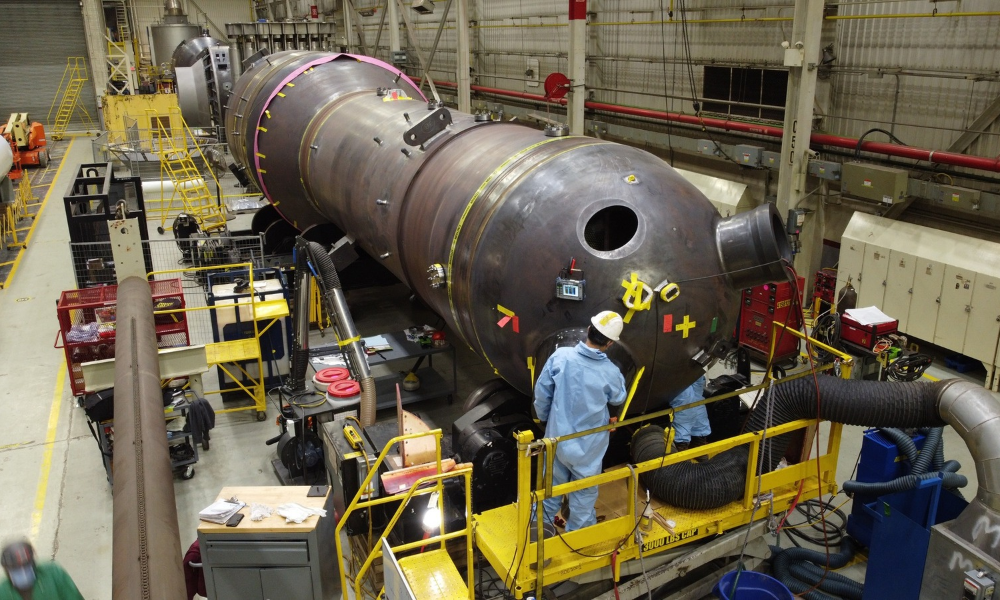
Workers operating in BWXT’s local facilities.
Waterloo is the right location for a fast-growing nuclear company
Growth is great for business, but it comes with challenges. MacQuarrie says BWXT Canada has created 200 jobs locally since announcing the expansion of its Cambridge facility in 2024. And now it’s aiming to recruit 200 more by the fall of 2027.
“That challenges the whole organization. When you’re growing at that rate, you go through a lot of change, and that can be tough on people even though it’s a positive thing,” he says.
Thankfully, the company happens to be located down the street from three of Canada’s premier post-secondary institutions: The University of Waterloo, Wilfrid Laurier University and Conestoga College.
“We’re fortunate to have good universities nearby, so we have pretty good access to engineering talent. The college is strong too, and we recruit from all of them for skilled workers and technicians,” MacQuarrie adds.
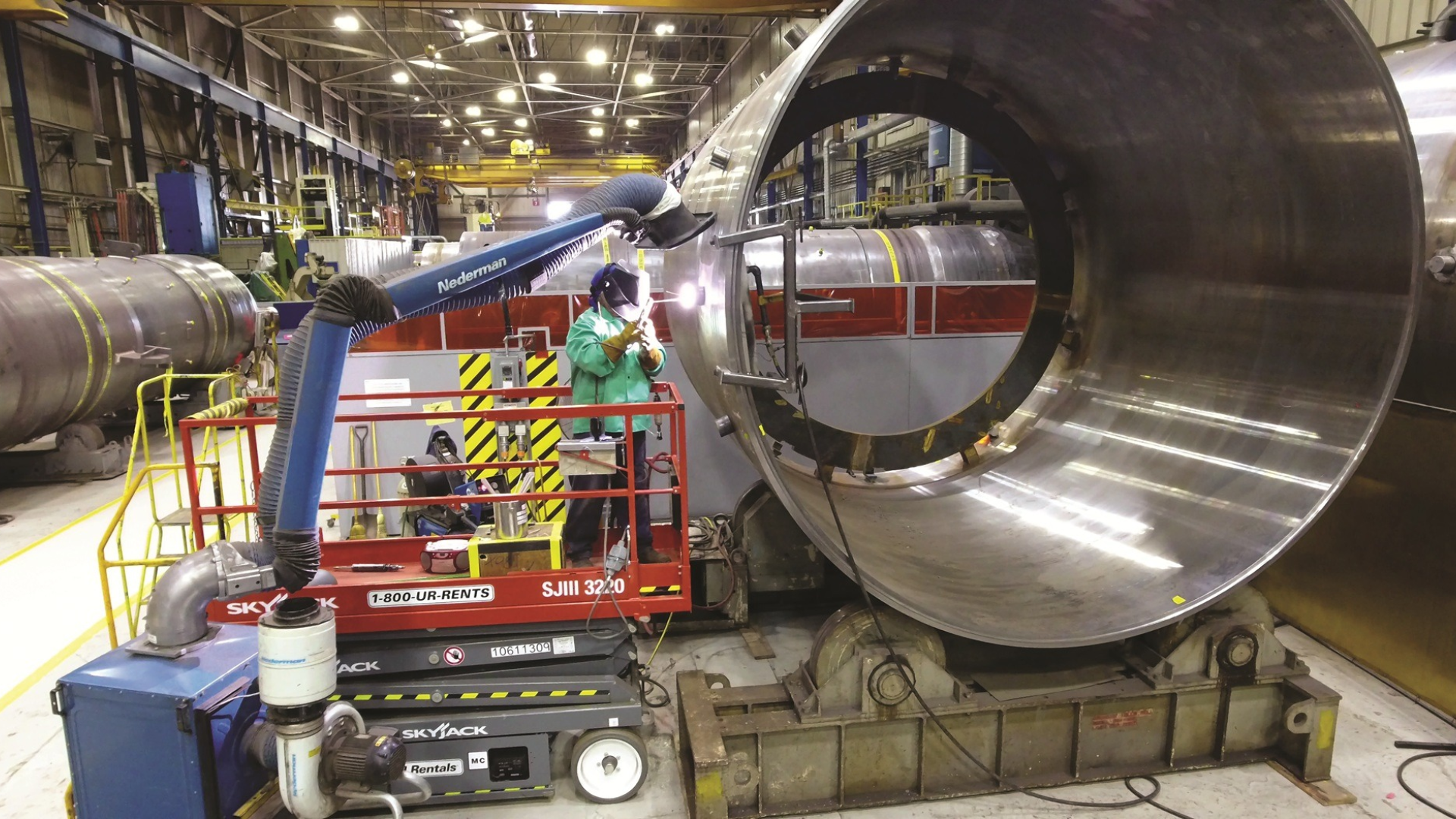
The schools produce great talent, but nuclear professionals need a specific set of competencies. MacQuarrie explains that BWXT equips its new hires with those skill sets. For welders, BWXT’s welding school upgrades their skills to be certified as a nuclear welder. The upskilling goes beyond the classroom and onto the shop floor.
“Younger engineers are mentored alongside senior engineers, because they need that time before they can operate more independently. So, we recruit from good schools and programs, then take people further, to the specific level we need,” he says.
The company’s locations in the Waterloo region continue to help it attract talent, connect with global customers and drive innovation.
“This region has been an industrial hub since our company started here in 1844, and that inertia has been maintained,” MacQuarrie says. “There are a lot of suppliers here. There’s a favourable business climate. That’s created a cluster of sorts, and you operate more efficiently when you’ve got suppliers nearby, access to talent and support from colleges and universities. There are very few places in Canada as good as this area for it.”
The Summary
- BWXT is a world leader in the design and construction of large reactor components, small modular reactors and micro-reactors.
- The company has two locations in the Waterloo region, its 280,000 square-foot Cambridge manufacturing facility and a new 150,000 square-foot training and field services facility in Kitchener.
- BWXT Canada continues to grow rapidly, creating 200 local jobs since announcing its Cambridge facility expansion in 2024 and targeting 200 additional hires by fall 2027.
- BXWT continues to innovate in the nuclear space with smaller, safer and more efficient designs that are generating global interest.
Find nuclear opportunities in Waterloo
Join BWXT, and a legion of nuclear innovators, in our ecosystem. Here, your company can build critical infrastructure and join the provincial supply chain.